Reviewed and edited by Anna Phillips-Waller, BSc Psych | Health Behavior Change & Clinical Trials Expert
How many of our parents told us as children that life wasn’t easy? Most of us interpreted that as being about the challenges we’d face choosing a career, raising a family, dealing with frozen pipes in wintertime, and so on.
It likely never occurred to us that there were a number of disconcerting facets to human existence that we all find difficult, but seem to have collectively agreed never to discuss with one another. The things listed below are the main ones that most of us struggle with, but rarely get mentioned.
1. Humans are the only species on the planet that need to pay for the right to exist here.
Every other species alive on the Earth is born just to exist. Food and water are abundant for most of them, they can build their homes where they like, feed themselves however they can, and so on.
Meanwhile, humans have to “earn a living” in order to be fed and sheltered. We have to pay for the right to marry whom we like, to feed our families, to access national parks and waterways. None of us asked (or agreed) to be here: others made that choice for us. And now we have to pay for that privilege every day that we’re alive.
2. The unpredictability of our corporeal vessels.
Having a body in order to navigate life here is like being handed keys to a random vehicle you had no input in choosing.
You have no idea what the expectancy is like, whether it’s in good working order, nor do you have much say in its appearance. Sure, you can have it painted and upgraded, but those are mostly cosmetic “fixes.”
Life would probably be a lot easier if we were given a guidebook on how to work with our bodies, namely what illnesses we’ll have to navigate with them, how long they’re going to last, what genetics they may pass on, etc.
3. The helplessness of being unable to make big changes happen as an individual.
Very few of us are multi-billionaires who have the resources available to make big, positive changes happen on this planet.
We do what we can with what we have, but it’s difficult not to feel overwhelmed and helpless when we see endless stories on the news and social media about all the horrible things happening around the world.
We can “think globally, act locally” and try to serve our own communities, but that’s a drop in the ocean as far as major global concerns and conflicts go.
MY LATEST VIDEOS
Playlist advancing in 5 seconds
Ad ends in 0
Video Paused
Neither you nor I can stop famine, war, genocide, or climate change, so we avoid those heavy topics in favor of things we can affect.
4. How tiring and tedious keeping ourselves alive can be.
Being an adult feels like deciding what to have for dinner every single night, forever. We often don’t know what we actually “feel like” having, but instead go for whatever meets the magical combination of being edible and is easy to put together — even if it’s just a bowl of cereal or DoorDash ramen.
We have no choice about this either, since we have to eat to stay alive. And more than that, the foods we decide to consume will directly influence our overall health.
So not only do we have to eat, but we have to make a conscious effort to eat as well as possible, within our financial means and culinary capabilities, and so on. It’s exhausting.
5. Not knowing whether there’s actually any meaning to being here.
Life is an astonishingly coincidental thing. In fact, apparently, the chances of you actually being alive right now are about 1 in 102,685,000. That’s 10 followed by 2,685,000 zeros, and to give you some context, the universe only has 1080 atoms.
That’s an astonishing rarity, and makes your existence rather miraculous. As such, it can be confusing and conflicting to be told by numerous religions and philosophies that there’s great meaning and sacredness to life, whereas science reinforces the randomness of life on this planet.
The Romantic poet John Keats had “Here lies one whose name was writ in water” on his gravestone as a commentary on the ephemeral nature of existence.
Although some famous people are remembered for thousands of years, the vast majority of us will be forgotten after a couple of generations. Maybe that’s why a lot of folks see their children and grandchildren as their legacy, or otherwise try to create or do something of great note — so their story doesn’t fade away like dust in the wind.
6. How much of everyday life involves pretense.
When you think about how often you’re expected to be inauthentic on a daily basis, it’s difficult not to feel depressed.
Maybe you’re expected to be pleasant and cheerful at work, even though your colleagues drive you insane, be affectionate with your partner and kids when you want nothing more than a few blessed minutes to yourself, or tell your mother-in-law how delicious her kidney and asparagus casserole is because she went through all that trouble to make it for you.
Subscribe to receive our latest articles!
🙂One convenient email, no spam, easy to unsubscribe.
Most of the time, it seems as though the numerous lies we tell every day aren’t just acceptable, but mandatory in order to remain on good terms with those around us.
This is quite counter to the fact that most of us were raised with the belief that lying is bad and should be avoided at all costs. So we just don’t discuss that hypocrisy with one another, and simply nod and smile our way through excruciating interactions as need be.
7. Miscommunication because we can’t read others’ thoughts.
Life would be so much easier if we could communicate telepathically on occasion. Not all the time, of course: that would be terrifying. But it would be immensely helpful to occasionally be able to tap into another’s brainpan to truly understand what they mean and how they feel, or to let them know our own thoughts and emotions.
The clicks and buzzes we manage to make with our own mouths don’t always clearly express what we have in mind, and countless arguments may be avoided if we were simply capable of beaming our thoughts into one another’s minds.
Oddly enough, many people around us expect us to be able to do exactly that, and get angry with us if we don’t intuitively “know why they’re upset”!
8. Change is constant, and can be difficult to navigate.
“Omnia mutantur, nos et mutamur in illis.” This translates to: “All things change, and we change with them.”
The very nature of existence involves change, whether it’s the metamorphosis from a small seed to a towering tree, the shift from a sunny day to a thunderstorm and back again, or the nature of interpersonal relationships.
Most people like to have a certain degree of certainty and stability in their lives, so they aren’t constantly wracked with anxiety. But in reality, nothing is ever certain, and that’s a terrifying thing to accept.
We’ve pretty much agreed not to talk about that, and instead place great emphasis upon establishing and maintaining stable relationships, jobs, home lives, health, and so on.
We play pretend about the illusion of security, conveniently ignoring the fact that every single aspect of our lives is ephemeral and ever-changing, so we don’t go mad.
The Buddhist perspective on impermanence (Anicca) can be helpful for navigating this. It teaches that the greatest source of human suffering (Dukkha) usually stems from trying to cling to things we love and enjoy in order to freeze them in time, instead of accepting their natural transience.
9. Not knowing what happens after we die.
Death isn’t a topic that most people are comfortable discussing, even though the probability of that event happening is exactly 1 in 1.
We talk about grief when we lose a loved one, of course, but for most people, the process of death and what happens afterward aren’t topics that they’re comfortable discussing.
People who adhere to certain religious beliefs are often more comfortable talking about what happens after death (i.e., heaven, reincarnation), but even they may not be overly eager to focus on that topic too often.
Most people are afraid of dying, even those who have strong faith, so as a collective, we pretty much agree not to talk about it unless we absolutely have to.
Final thoughts…
Most of us have learned how to compartmentalize the disconcerting things about being alive effectively enough to function on a daily basis. Even little things like hyper-awareness of our own pulses, or the fact that our internal organs are constantly jiggling around, can be immensely disconcerting.
We don’t talk about the things listed here because to draw attention to them would mean having to process them, and we generally have bigger issues to deal with.
Being alive is beautiful and miraculous, but also incredibly difficult. We’re all doing our best, though, and that’s something to celebrate.

Finn Robinson has spent the past few decades travelling the globe and honing his skills in bodywork, holistic health, and environmental stewardship. In his role as a personal trainer and fitness coach, he’s acted as an informal counselor to clients and friends alike, drawing upon his own life experience as well as his studies in both Eastern and Western philosophies. For him, every day is an opportunity to be of service to others in the hope of sowing seeds for a better world.
Do not sell or share my personal information.
You have chosen to opt-out of the sale or sharing of your information from this site and any of its affiliates. To opt back in please click the "Reenable Personalization" link.
This site collects information through the use of cookies and other tracking tools. Cookies and these tools do not contain any information that personally identifies a user, but personal information that would be stored about you may be linked to the information stored in and obtained from them. This information would be used and shared for Analytics, Ad Serving, Interest Based Advertising, among other purposes.
For more information please visit this site's Privacy Policy.
CANCEL
CONTINUE
Before Simón Bolívar Could Liberate a Continent, He Had to Fight an Earthquake | The Nation
On June 24, Venezuelans were struck by two powerful, back-to-back earthquakes, each measuring more than seven points on the Richter scale. The destruction is widespread, especially in Caracas and the coastal city of La Guaira. There’s now more than a thousand dead and thousands missing, but those numbers are going to grow. One hesitates to politized natural disasters, to rush to impose some larger moral geopolitical morality on heartbreak. But—considering that Washington has placed Venezuela in receivership and has seized billions in oil revenue, depositing the money in US escrow accounts—it’s hard not to. Over the lasts two decades, Washington has sanctioned Venezuelans to death. The White House, in the wake of the quakes, has lifted some of those sanctions, but the damage has been done, leaving government and society with a significant lower capacity to cope with the damage. The United States flew 149 Venezuelan deportees, including 19 women and seven children, from Miami to Caracas just a few hours before Wednesday’s earthquakes. They were brought to brought to the Hotel Santuario La Llanada in La Guaira, which collapsed. Hundreds remain missing.
What follows is an account of an earthquake that hit Caracas in 1812, one whose aftershocks changed the world. The quake led to the end of Spanish America’s first independent republic but propelled a young Simón Bolívar to the head of a continental insurgency that, about a decade later, would topple the three-century old Spanish Empire. It’s an adapted excerpt from my America, América: A New History of the New World, which is now out in paperback.
—Greg Grandin
More
Settings
Full Screen (F)
Play (SPACE)
Read More (Shift + O)
Quality Auto
Connatix
V499024420
Quality
360p
720p HD
1080p HD
Auto(360p)
00:00
03:12
360p
720p HD
1080p HD
Auto(360p)
Connatix
V499024420
Read More
1/1Skip AdContinue watchingafter the adVisit Advertiser websiteGO TO PAGE
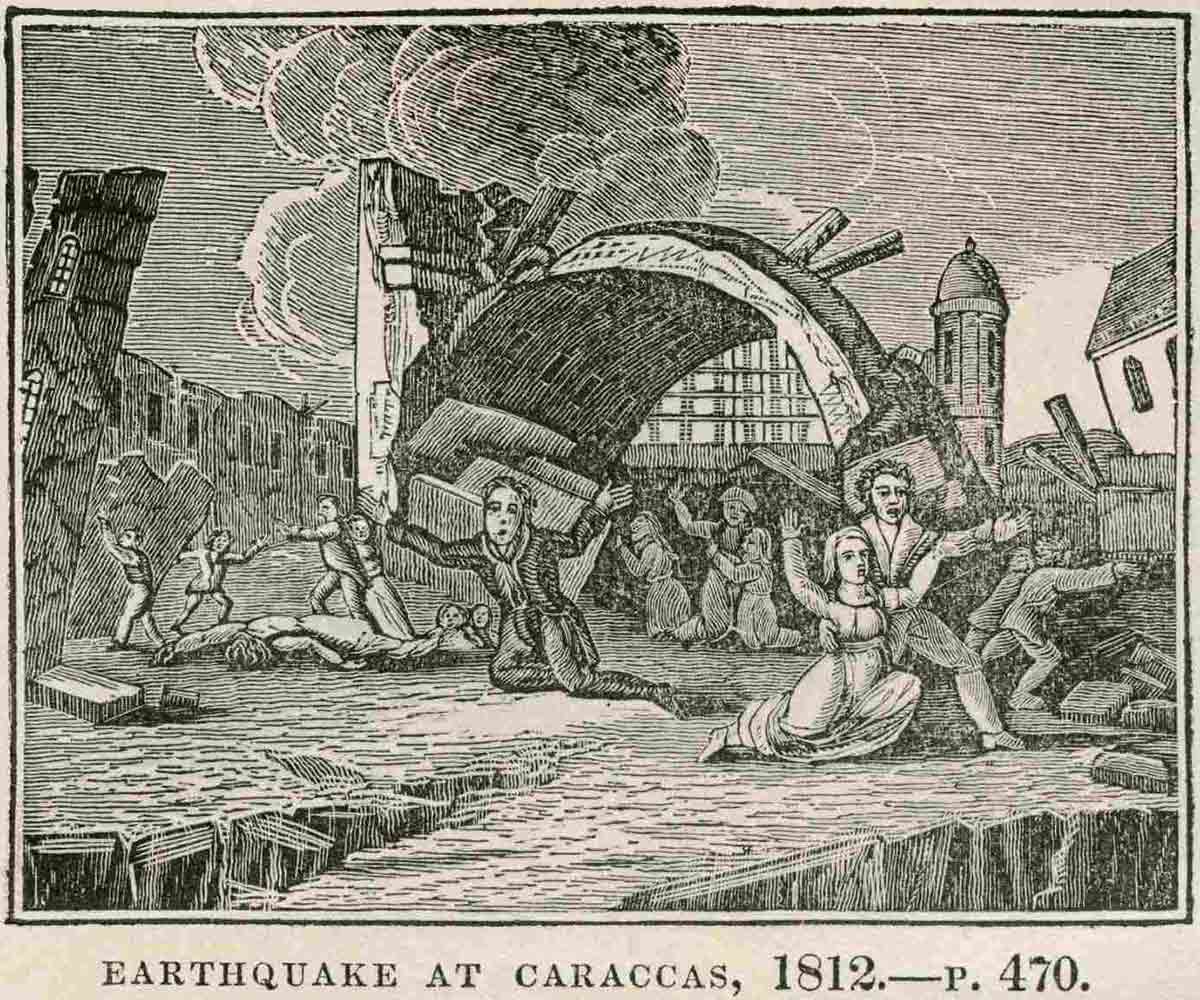
Thursday, March 26, 1812, Caracas: What image better captures the cusp between old and new than Simón Bolívar standing defiantly on a mountain of rubble? His audacity signaled not just the beginning of the end of Spanish colonialism but the breaking of the chain that linked slave, peasant, servant, man, woman, priest, master, lord, and king in a hierarchy reaching to the sky, a sky crisp and clear that tragic Thursday. The earthquake had destroyed most of the city and its hinterlands. At one point, Bolívar, who was back in Caracas from his military campaigns when the quake hit, drew his sword on a priest and ordered him to stop praying for souls and start saving lives. Pull bodies out of the rubble, Bolívar ordered the cleric. After scrambling atop a high pile of stones from a ruined convent, Bolívar came face-to-face with José Domingo Díaz, a medical doctor loyal to Spain who for two years had written weekly polemics against the foolish dreams of republican liberation. Bolívar, as Díaz described him, looked desperate.
“What now?” Díaz asked, as if mocking the republican arrogance that it was history that mattered, that it was history that could be overcome by man’s will—that it was history and not nature that decided who ruled. Bolívar’s answer came back quick: Si se opone la naturaleza lucharemos contra ella y la haremos que nos obedezca: If nature itself opposes us we will fight nature and make it obey.
There’s nature as reason, as a justifier of beliefs and ideals. And there’s nature as force, impulsive, terrifying, and marvelous. Bolívar, climbing the convent’s rubble and pledging that he would compel nature to submit to republican will, was defying both. He wasn’t disputing the royalist argument that the natural disaster was a manifestation of God’s displeasure. But if true, then God’s will had to be defeated and the old world He presided over had to end. During this moment of earthshaking crisis, Bolívar was Milton’s rebel angel hurling defiance toward the vaults of heaven. If nature stood in the way, nature would be destroyed.
After surviving Caracas’s 1812 earthquake, Bolívar would spend the next 12 years of his life waging war against Spain, and against the institution that enriched Spain: slavery, in all its many guises.
Caracas had been suffering from a long drought that spring, and the sky was blue on the day of the quake. But a few raindrops fell just before the church bells started to ring: at 4:07 in the afternoon, not to mark time but because their towers were swaying. The undulations of the earth came from different directions, north to south, and east to west, like two waves cutting across each other.
The city sat at the intersection, and the waves crashing together sounded like thunder rising from “hell,” one survivor said, like the “voice of the Angel of the Apocalypse.”
Columns gave way. Balconies fell. The timing of the earthquake was uncanny. March 26 in 1812 was Maundy Thursday. On that day two years earlier, Caracas had expelled its royal overseers. On that day one year earlier, the city had commemorated the expulsion in a wild night of revolutionary exuberance, and then shortly thereafter declared independence. Believers were in the city’s many churches and convents celebrating Mass when the buildings started to collapse, and many of them, maybe most, were crushed to death. When the sun went down at 6:10, the dust rising from the rubble deepened the darkness. The “lamentations” of those buried beneath the ruins “lacerated the heart,” recalled one witness. The destruction was near total, the terror absolute. Washington’s envoy to the new republic estimated that 20,000 people had died immediately, and tens of thousands more would perish in the weeks to come from hunger, disease, and injury. Church buildings in wealthy mantuano parishes were made of heavier stone, with larger buttresses, so most of them remained standing. Casually built churches in poorer areas of the city nearly all collapsed, crushing the city’s servants, along with their children. This meant that there was a shortage of laborers and domestics to help upper-class families recover: a preview of what a world without slavery might look like.
The quake radiated hundreds of miles beyond Caracas. Town after town fell, with waves felt as far west as Bogotá in Colombia. Storehouses collapsed, burying shovels and other needed tools, medicines, linen, and food. Rescuers used their bare hands to dig survivors out from the rubble. The quake blocked springs and broke pipes running to public fountains, so there was little safe water to drink or to clean wounds. Suddenly, for the well-off, the abstractions of revolutionary slogans proclaiming liberty and equality were materialized in their worst fears: The city’s poorer survivors were seen “entering the houses that were still standing” and “carrying off everything they could lay hands on.” Some called it looting, though it might more rightly describe survival. To prevent the spread of disease, bodies were burned by the dozens. Corpses were carted to the beach of La Guaira, Caracas’s port town. There, they were burned “about forty at a time in one fire,” with the flames visible to ships far out in the Caribbean.
“The City has disappeared,” wrote the Prussian naturalist Alexander von Humboldt, who had visited Caracas during his American travels, upon reading of the catastrophe. So too, for many, republicanism. Congress held its last session on April 6, 1812.
Nine out of 10 prosperous caraqueño houses, compounds in the Andalusian style, thick adobe chambers surrounding lush courtyards, were destroyed. Simón Bolívar’s, just off the Plaza San Jacinto, survived. Its beams buckled but held. Witnesses recalled the 29-year-old Bolívar in a tattered, stained shirt with sleeves rolled up, alternating between pulling people from the wreckage and arguing with those who said the calamity was a divine strike against republicanism, against the “sin of independence.”
Disaster Royalism
Republicanism in Venezuela, as mentioned, wasn’t anti-Catholic. In Caracas, as well as in key provincial cities, especially in the Andean city of Mérida, there existed emancipationist priests, of the kind that might read a passage from Las Casas rather than a chapter of the Gospel while saying Mass. But a larger, opposing group was mobilized by Archbishop Coll y Prat. A few conservative clerics had been preaching for years against republican perversity, warning of the wrath that might befall a people arrogant enough to believe they could rule themselves. Others held their tongue. Until Caracas collapsed.
The archbishop, born in the Cataluña foothills of the Pyrenees, urged his priests to preach disaster royalism. They were to tell people that “hell was opening to swallow them.” Clerics cited the fact that the city’s buttressed cathedral was spared destruction as evidence that God protected the faithful. Christ’s Crucifixion, people were reminded, was followed by a similar upheaval: “And the earth did quake, and the rocks rent.” The destruction was “terrifying,” Coll y Prat remembered. But “well deserved.” The earthquake “confirmed for our times the timeless prophecies revealed by God to men about the ancient cities impious and proud: Babylon, Jerusalem, and the Tower of Babel.”
Royalists who had previously fled republican Caracas, many to Caribbean islands where no integrated balls were held, came home. They brought with them a new stock of servants and a strong dose of Catholic revivalism, including exaggerated displays of public penance. Survivors and returnees roamed the streets in impromptu processions, dressed in sackcloth, dragging makeshift crosses, and confessing their sins. The churches left standing were packed day and night, and anyone who didn’t, according to one account, “surrender himself to the ridiculous mania of living in penance was regarded as a dissolute libertine who provoked the anger of heaven.” Not just republicanism but all transgressions were regretted. Couples living together out of wedlock sought out priests to marry them. Fathers recognized their bastards. Republicans lost their audience.
The drought let up after the quake. Hard rains that would have been welcome in any other year now tormented a city not given time to repair its roofs or drainage systems.
Caracas’s conservative clerics were quick to seize on the marvelous to strike at the republic. Aftershocks continued for weeks; another large quake on April 5 threw the ground into a “state of perpetual undulation.” For many, there existed “only one recourse.”
Make peace with God. And stop calling one another citizens.
Chastisement of Heaven
In Spain, the Cortes de Cádiz had been too occupied fighting Napoleon to mount a full military campaign against republican Venezuela. It left the pacification initiative to a loyal, poorly armed frigate captain named Domingo de Monteverde. Short on men, Monteverde had begun to try to win over some of those insurgentes de otra especie who were stirring in rural Venezuela. Before the earthquake, Miranda and Bolívar, as leaders of the republic’s defending army, had kept Monteverde in check. After the quake, though, with disaster Catholicism spreading fast through the land, the counterrevolution grew.
The United States hadn’t officially recognized the Venezuelan republic, but it did send a consul, Robert Lowry, to Caracas’s port city of La Guaira to monitor events. In June, he reported to Secretary of State James Monroe that royalist forces had “penetrated” deep into the interior. Monteverde’s army was growing with “superstitious” recruits who had been “excited by the Priesthood.” The earthquake, they were told, “is a chastisement of Heaven for abandoning the cause of Ferdinand the Seventh.”
The counterrevolution had begun to consume the revolutionaries. The Sociedad Patriótica successfully demanded that the government name Miranda “dictator,” giving him extraordinary powers to put down royalists. Miranda ordered the arrest of all Spaniards and Canary Islanders (mostly merchants who had prospered under Spanish mercantilism and were thus hostile to the independence movement).
The republican army had been enfeebled by the quake and the chaos of its aftermath. So Miranda took steps to bolster its ranks by finally fulfilling a promise that he had made to British abolitionist William Wilberforce to end slavery. The revolution had already ended the slave trade. Now, Miranda issued a decree promising “liberty for all slaves that take up arms for Venezuela.” The city’s white elite and conservative clergy were outraged. They understood Miranda’s edict as “an attack on their property and dissolvent of the social order,” a perilous unleashing of forces best kept chained.
A tipping point had been reached. In response to Miranda’s decree, anti- republicans did the same. They began to mobilize people of color. Archbishop Coll y Prat sent secret instructions to priests in the provinces to encourage enslaved and free Blacks to fight in defense of our “legitimate sovereign.” A rumor spread throughout the provinces that the archbishop had been taken prisoner, and soon a column of armed people of color was marching on the city to rescue the cleric and “end the republican government.” By the end of June, reports came in that large stretches of the coast east of La Guaira were under the control of royalist negros and pardos. Miranda had pulled troops out of the city to attack Monteverde, leaving Caracas undefended against the archbishop’s would-be rescuers, whose battalion was 12 leagues from the city’s gates and moving fast.
Miranda didn’t have the will or heart to fight back. He was, at this point, carrying on back-channel communications with London officials, who were urging moderation. Miranda opened talks with Monteverde, and, in exchange for being allowed to return to London, surrendered on July 25, 1812. Spanish America’s First Republic was no more.
Bolívar was enraged. Miranda might have believed he had no choice, but his former comrades charged him with treason. Still, Miranda, caught in his lassitude, delayed his departure for London and that delay allowed a group of revolutionaries, including Bolívar, to capture the old general and turn him over to the royalists. What exactly happened next is unclear, but Monteverde’s promise of safe passage was revoked. Royalists sent Miranda to Spain, where he died in a prison cell on July 14, 1816, on the 27th anniversary of the fall of the Bastille. Bolívar, after giving up Miranda, gave up the fight as well, for the moment. Monteverde’s troops allowed him and a handful of revolutionary officers to escape to the English island of Curaçao, on a small sailboat named Jesús, María y José, where the exiles were given shelter by Mordechai Ricardo, an Amsterdam-born Jewish lawyer (and cousin of the economist David Ricardo).
Monteverde entered Caracas at the end of July and began arresting the city’s remaining republicans, including the drafters of the Declaration of In- dependence and the constitution. Calling them “monsters of America,” Monteverde imposed, according to the United States envoy charged with delivering food relief, a “system of proscription, sequestration, imprisonment, and cruelty almost unexampled.” They were put in irons and thrown into dungeons, “noxious in all countries, but doubly fatal in a climate like this.”
The Country Is America
Taking control of Caracas was relatively easy. More difficult for Monteverde was putting down the rural insurgentes de otra espiece, including those he had mobilized himself. The column determined to rescue Archbishop Coll y Prat was now camped on the outskirts of the city. The archbishop sent a message ordering slaves and peasants to return to their masters. The church was safe, I am safe, he said. The leaders of the march refused to disperse. Instead, they invoked Miranda’s decree, saying that by fighting for king and Church they should receive their freedom. “Nonsense,” said the archbishop. We “promised you nothing.”
The leaders of the assembled masses let Spanish officials know that their allegiance was conditional. They had already killed several of their “masters, overseers, and many whites” and could easily expand their ranks, raising an army of thousands of enslaved and free Blacks. “All armed,” as the archbishop’s envoy noted. Suddenly, victorious royalists were faced with the prospect of having to fight the forces that helped carry them to victory. As the archbishop’s envoy noted, the ragtag army bivouacked outside of Caracas could easily live off the land. “They all have been hardened by labor and the torrid heat.” Rumors began to circulate that their leaders were in contact with republicans, who didn’t hesitate to confirm that if they switched sides, they would indeed be emancipated.
Negotiations averted a siege of the city, and the “black corsairs,” as the archbishop called them, retreated. But Venezuela fell into chaos. Monteverde was injured in battle in October 1813 and eventually relieved of duty.
To the fore of the royalist pacification campaign came a ruthless horseman from the eastern llanos, or grasslands, named José Tomás Boves. Royal officers had released Boves from prison, where he was being held on charges of smuggling, and, after witnessing his merciless efficiency in the field, set him loose.
Essentially operating as a paramilitary field marshal, Boves practiced a unique form of royalism, which consisted in the waging of relentless class and race war. He held an implacable hatred of both republicans and Venezuela’s antirepublican landed aristocrats. His army, at its height, counted 7,000 men, mostly former slaves, cowherds, and peasants, who raised a piratical black flag—what he called his “banner of death,” adorned with a skull and crossbones and the words “Liberty or Death”—in every town they occupied. They slaughtered republicans by the thousands and terrorized white aristocrats, threatening to divide their great estates among the impoverished masses. All in the name of King Ferdinand.
Meanwhile, Bolívar, who had eventually made it to Cartegena, in Colombia, regrouped. He raised troops and rode back to Caracas, defeating all opposition and taking the city again in 1813. But in the countryside, Boves’s army was growing, cutting a line of mayhem through the provinces. Caracas, at least, was again in the hands of republicans, the capital of a “Second Republic.” But Bolívar was no longer interested in creating a besieged backwater nation on the littoral of a vast continent. He became the agent of his mentor Miranda’s grander vision, pledging himself to fight for a greater America. “Para nosotros la patria es la América”—For us, the country is America, he declared in one field speech.
Bolívar, on June 15, 1813, in the city of Trujillo, decreed a “war to the death.” It wasn’t just a figure of speech. The struggle to recapture Valencia had given Bolívar a sense of how deep-rooted royalism was in the countryside and an awareness that it would take significant coercion to defeat monarchical allegiances. He wanted his troops to terrorize Spanish loyalists, to avenge the “horrific desolation” left behind by Monteverde and the atrocities committed by Boves. Tactically, he wanted the remaining “accursed race of European Spaniards” to know they had three choices: accommodate to independence, return to Spain, or die. Spaniards who conspired with the enemy would be considered traitors and executed. Those who joined the rebels would be given an “absolute pardon.”
Bolívar was making it clear that the war was not simply a colonial rebellion but a conflict between two nations, Spain and America. Once set loose, such furies were hard to contain. The more Spanish heads his soldiers took, the faster they rose in the ranks. Some of the first such trophies to arrive at Bolívar’s camp were cut from the corpses of an elderly aristocratic husband and wife, along with a note written in the victims’ blood.
Churches Filled with Blood
Boves continued his own war of extermination. In early February 1814, in the town of Ocumare, his army pillaged, raped, and murdered, cutting off “the noses and ears of inhabitants, the penises of the men and the breasts of women.” “Blood was everywhere.” Survivors took refuge in the Catholic Church. Boves’s marauders murdered everyone they found inside. In retaliation, Bolívar ordered the execution of hundreds of Spanish prisoners. Historians guess that, between February 14 and February 16, 1814, as many as a thousand Spanish prisoners were shot or macheted to death.
Earlier, during the First Republic, political terror had been relatively contained. That restraint now fell away. Bolívar thought mass executions would force Spanish officials to curb Boves. If the Spanish knew that they’d pay “dearly” for Boves’s “atrocities,” they would rein him in. Bolívar was wrong. Royal officers had no control over Boves.
By June, Boves had begun his march on Caracas. Along the way, Massacre followed massacre, with Boves’s men building pyramids with the heads of decapitated victims.
Bolívar couldn’t defend Caracas. His generals and their troops, having suffered staggering losses, were dispersed, and Bolívar didn’t want to test the loyalty of the people of the provinces, who he feared would join with Boves upon his advance. On July 6, 1814, he ordered Caracas evacuated. Thus ended the short-lived Second Republic. Twenty thousand residents hastily gathered what they could and left their homes, with republican officers stripping the churches of silver to finance the fight. With Boves descending on the city from the west, thousands fled eastward, while Bolívar escaped by sea. Boves entered Caracas and once again ordered the execution of all remaining white residents. There weren’t many left. He also ordered troops to pursue the refugees.
The exodus was chaotic. From the western plains to the eastern marshes, Venezuela was filled with roving armed men with shifting allegiances. Some refugees made it into republican-controlled territory. Others straggled. Thousands died, of snake bites, dysentery, and hunger, among other causes.
Boves’s troops moved fast. In October, his army arrived at the town of Cumaná, where a group of Caracas’s exiles had taken refuge. Another day of carnage. Another dance. This time, though, he had in his custody Caracas’s republican orchestra, headed by Juan José Landaeta (the composer of Venezuela’s national anthem, “Gloria al Bravo Pueblo”). He ordered the 30-member group to begin playing their instruments as his soldiers waltzed with the city’s widows. Blood from the day’s killing still moist on their boots turned the dance floor red. As the orchestra played, Boves took one musician out at a time to be executed. He ordered them to continue to play as he shot them in the head. When the last musician had been executed, Boves announced that the “party was over.” Then the rapes began.
“The roads and fields are filled with unburied corpses, the towns are leveled,” said a royalist tax collector, “the churches defiled and full of blood.”
Boves was a phenomenon difficult to explain. He turned everything on its head, a black flag–waving royalist waging a counterrevolution to spark a more profound revolution. He terrorized those who presumed themselves, due to their Spanish blood and white skin, immune to terror.
Boves shook Bolívar. Bolívar would continue to fight for more than a decade longer—as if he were sure the fight was worth it, as if he were certain that what came after Spanish rule would be better than Spanish rule. But he wasn’t sure. Boves represented a greater chastisement than any earthquake, a warning that the war against Spain would unleash powers resistant to reason, forces pulling Spanish America apart more powerful than those fighting to hold it together.
“All will return to its most basic element: matter,” Bolívar lamented during one of his dark moments. “Everything will become nothing.” His experience defending Venezuela’s republic deepened his conviction that a strong executive was needed to hold the forces of disunion at bay. Bolívar could express world-weariness in racist terms. “Guinea and more Guinea we will have,” he wrote, as it became clear that his enemy would not just be royalist troops and accursed Spanish but, in some places, masses of poor people of color. Yet for all his pessimism, Bolívar never posited race as an ontological category, an essence found in drops of blood.
Race was for Bolívar an artifact of history. Like Las Casas, whom he read and hailed as an “apostle” of freedom, Bolívar believed the Conquest was a crime, not just because of its violence but because it imprinted racial difference in its legal codes. “Everything that has come before us is wrapped in the black cloak of crime,” he sighed. The fight for independence wasn’t sparked by a divine touch from on high but came up through muck and mire, centuries of colonial exploitation: Spanish Americans, those who fought for and against independence, were “the abominable offspring of those raging beasts who came to America to spill her blood and to breed with their victims before sacrificing and discarding them.” Some of those beasts, like Boves, still prowled the land.
And Bolívar remained committed to emancipation, both as part of the republican ideal and as a military tactic, even though he feared that emanci- pation would evaporate elite support for republicanism. In Haiti to regroup and request assistance, which the free Haitian government provided (a thousand rifles, gunpowder, clothing, and military advisers), Bolívar pledged to continue to work to free South America’s slaves. “That portion of our brothers who have labored under the miseries of slavery is now free,” he said upon returning to the mainland; “From here forward, in Venezuela there is only one class of men: all will be citizens.”
Bolívar would continue to issue horseback emancipations, galloping from one hacienda to another and freeing its slaves if they promised to join his fight. Other revolutionary leaders in Argentina, Chile, and Peru—such as José de San Martín—did the same. Battalions of emancipated slaves helped win some of the most important battles of the independence movement, at Junín and Ayacucho, for instance. Montevideo, dubbed the New Troy after it lived under Spanish siege for more than a decade, never fell, thanks to its African defenders.
Nor did Bolívar, with Las Casas imprinted onto his consciousness, blanch from admitting that republicans were founding their new “free” nations on stolen land, that nationalism entailed its own form of colonialism. “We find ourselves engaged in a dual conflict: We are disputing with the natives for titles of ownership, and at the same time, we are struggling to create a new country.”
Whether such a new country could come into being or not—much less be a vehicle for justice—was a question left for the future. The fight itself was what Bolívar called an “obligation of atonement” to those who came before, especially to the “annihilated Indians” and their descendants. To break Spain’s hold on the New World was a debt “of the greatest transcendence.” Be there earthquakes or be there beasts like Boves, he’d fight on, even if “heaven has determined that our conquerors shall be our brothers.”
Boves was killed in battle by one of Bolívar’s men in 1814. Spain followed by dispatching an expeditionary army of 10,000 soldiers, along with a new suite of royal officials to impose order. The troops were led by Field Marshal Pablo Morillo. There wasn’t much left of Boves’s counterrevolutionary army, and those soldiers who had survived were in rags.
“If these are the victors,” Morillo asked, of the men who had defeated Venezuela’s Second Republic, “who are the vanquished?”
In the years to come, Bolívar would march through Indigenous communities, cattle lands, and haciendas worked by peons and slaves, continuing to offer freedom for all who joined the fight. Bolívar the utilitarian thought, abstractly, that racial divisions could be transcended with education. Bolívar the military leader hoped that war would create unity. Bolívar the existentialist doubted that any of it would matter.
And so by 1824, enslaved peoples were abandoning their masters and signing up to fight the Crown in exchange for their emancipation. Indigenous peoples came down from their highland villages, hoping that, after centuries of colonialism, their lot would improve under republican rule. One of the last battles of the long war for independence would take place in August, in the marshy highland plains of Junín, with Bolívar’s 8,000-strong army routing Spanish troops.
Save for a few last skirmishes, Bolívar had decisively defeated Spain.
Still, in victory, he remained haunted. He’d return again and again in future writings to history’s capriciousness, to a gloom that could rival the prophet Amos. “My time is a time of catastrophes: Everything created is destroyed in a flash, like lightning,” he wrote to his former vice president. “How foolish I was to believe I could stand firm in the midst of such convulsions, in the midst of so many ruins, in the midst of the universe’s moral upheaval.… It would be madness to see the storm that is coming and not take shelter.”
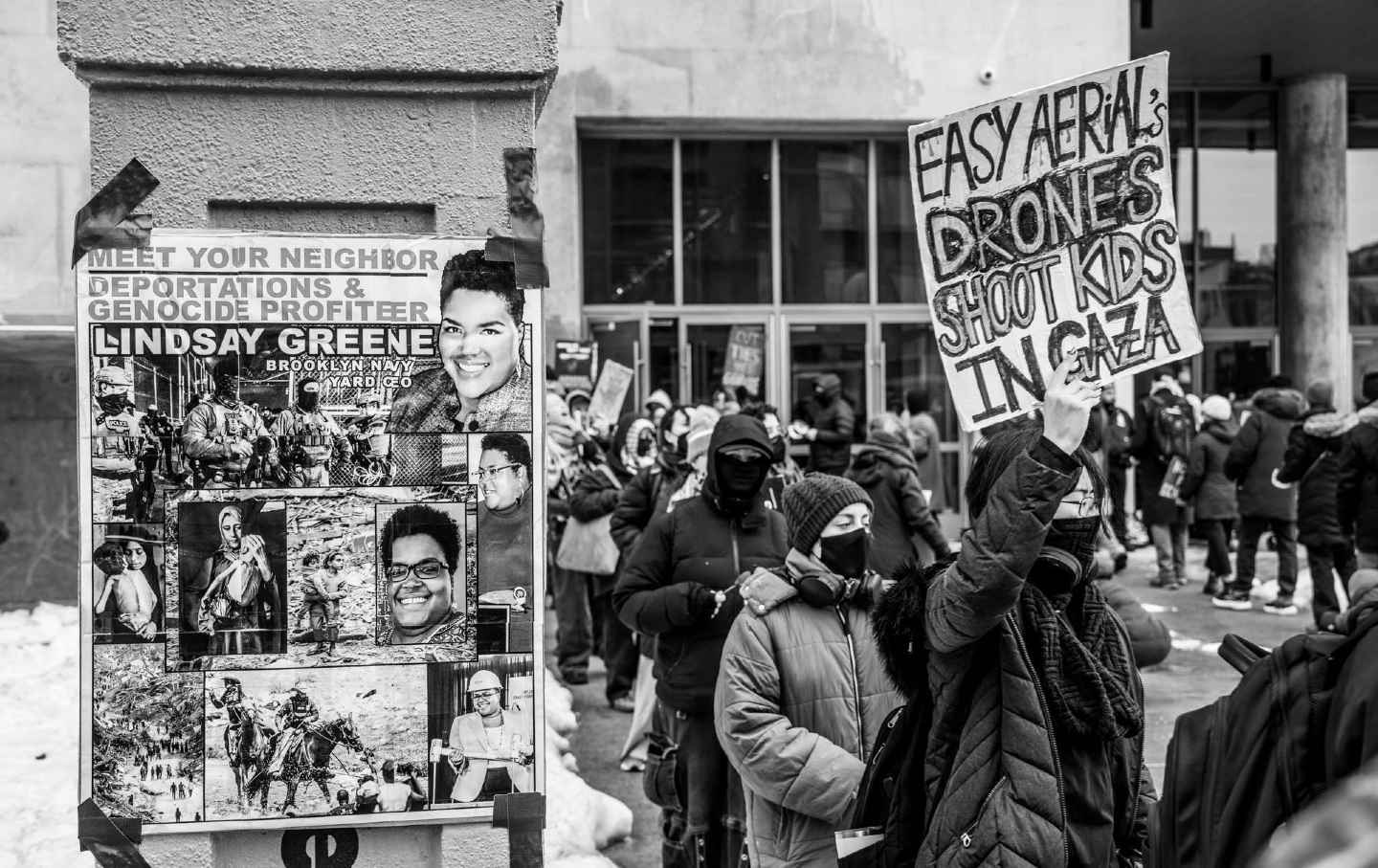
Newly uncovered documents have provided the first definitive proof that Israel’s largest weapons supplier is purchasing drones built in the Brooklyn Navy Yard.
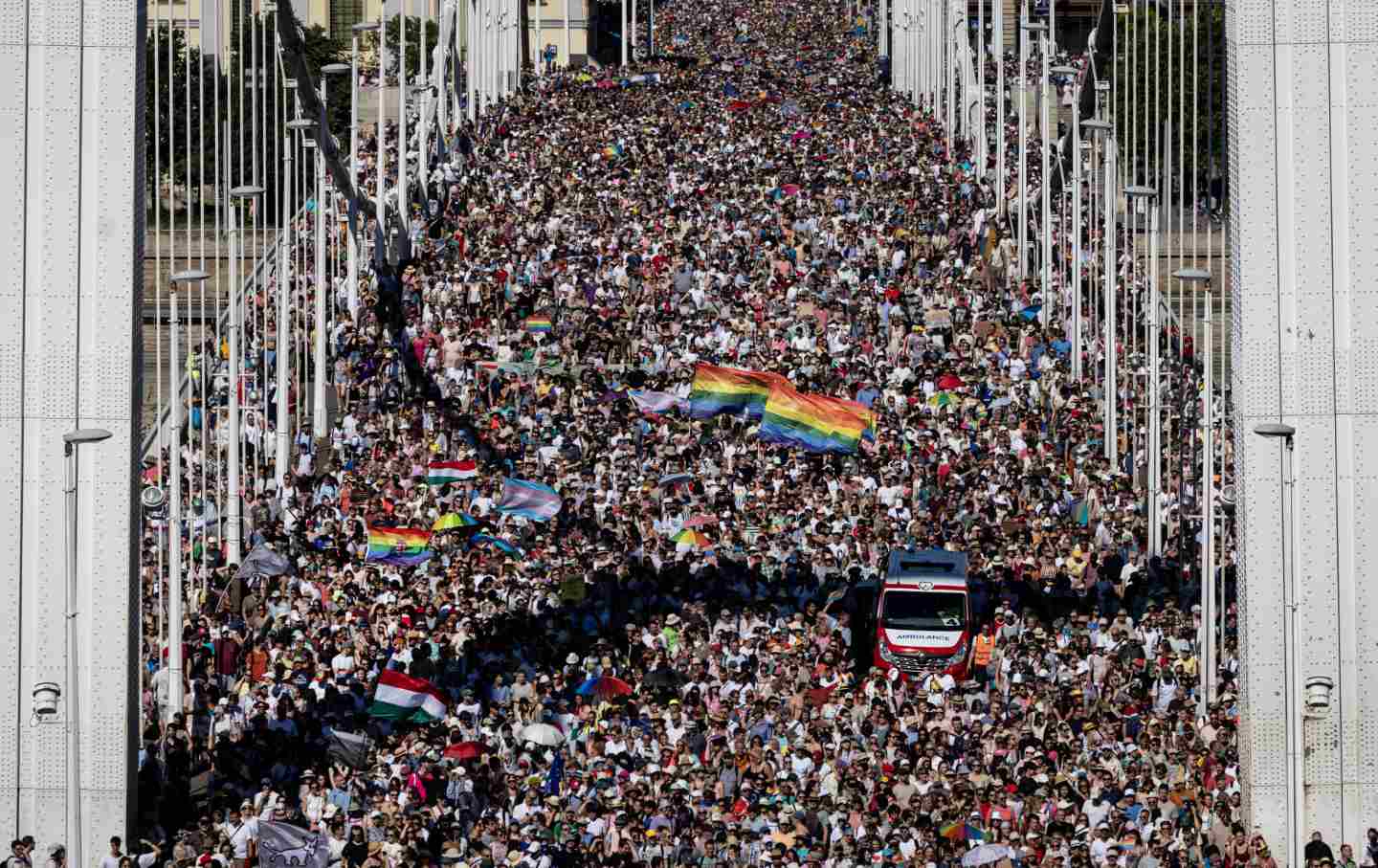
Around the world, governments are scapegoating LGBT people to build popular support for their erosion of individual rights—often under the guide of protecting children.
La Moskitia, Honduras—The DHC-6 Twin Otter from Tegucigalpa touched down on a 12,000-foot strip of dirt. There was no signage confirming that this was the Puerto Lempira airport in eastern Honduras. Most passengers carried suitcases and boxes brimming with food, clothing, medicine, and other materials. But I had traveled light, ready to cross more than a hundred miles of rough road to reach inland communities where I hoped to better understand the allure of one of the most beautiful—and most highly coveted—birds in the world: the scarlet macaw, known to the Afro-Indigenous Miskito majority as the apu pauni.
Puerto Lempira—the capital of Honduras’s easternmost state, Gracias a Dios—sits on the edge of La Moskitia, a 14,000-square-mile rainforest often called “the second Amazon” and “the lungs of Central America.” In English, it’s known by the exoticized misnomer The Mosquito Coast. (Oral tradition says La Moskitia is named for Miskut, a legendary Indigenous leader—not the blood-sucking insect.) Until 1957, Gracias a Dios—literally “Thank God”— remained largely unmapped and had no formal government presence. Its remoteness—pipantes (motorized canoes) and small planes are the main mode of transportation—has helped protect its scarlet macaw population, but it has also made it a haven for groups looking to avoid the law and whose activities now threaten the iridescent bird.
More
Settings
Full Screen (F)
Play (SPACE)
Read More (Shift + O)
Quality Auto
Connatix
V499024420
Quality
360p
720p HD
1080p HD
Auto(360p)
00:00
03:12
360p
720p HD
1080p HD
Auto(360p)
Connatix
V499024420
Read More
1/1Skip AdContinue watchingafter the adVisit Advertiser websiteGO TO PAGE
My mission in La Moskitia was a simple one: to see if and how it’s still possible for scarlet macaws to live in harmony with humans in a shared community. I had already visited several macaw conservation projects run by universities, nongovernmental organizations, and wealthy individuals across Central America and the Caribbean. But as important as these efforts are, few of these incorporate Indigenous people whose ways of living have sustained both the birds and the forests they’ve lived in for millennia.
In La Moskitia, the fates of the Miskito and the scarlet macaws are inseparable. By dispersing seeds, the scarlet macaws regenerate the forests that feed the Indigenous communities, who in turn safeguard the bird. Now both the macaw and the people are under threat: Poachers raid nests for eggs bound for international buyers; settlers burn down forests for cattle and agriculture; and narco-linked groups exploit the region’s lawlessness to traffic along La Ruta, the mass of jungle and forest they use to move billions of dollars worth of drugs north.
Create a free account to continue reading
Or, click here to subscribe for $3.99 a month and
get unlimited access to 160 years of The Nation.
Or, click here to subscribe for $3.99 a month and
get unlimited access to 160 years of The Nation.
Thankfully, I wouldn’t be undertaking the six-hour drive to La Moskitia’s villages alone. Outside the airport’s rusty gate, Santiago Lacuth, a leader in the Miskito village of Mavita, greeted me with a hearty smile, and beside the lanky Lacuth was Lorakim Joyner, a five-foot-tall Atlanta-born wildlife veterinarian and Unitarian Universalist minister who leads One Earth Conservation, a US nonprofit that works with parrot preservation efforts. They stood in front of a faded white 2005 Toyota pick-up truck. Packed with barrels of water, boxes of foodstuffs, electrical equipment, and other materials for Mavita, the Toyota had the look and feel of a reliable but tired workhorse, a Rocinante with cracked windows.
The sides of the Toyota were emblazoned with a luminescent yellow, blue, and red parrot soaring against a blue sky. Above the image were the Spanish and Miskito words: Proyecto Apu Pauni, or the Apu Pauni Project. After stalling momentarily, the Toyota awakened, and our journey to Mavita began.
Anticipating a long, bumpy ride, I asked Lacuth and his son Jarri, who sat next to me in the back wearing a baseball cap to teach me how to say things in Miskito. Their native tongue bears the marks of regional history, migration, and conquest. Miskito is a mix of local Indigenous Sumu and other regional languages, South American Chibcha, Nahuat (the language of the Aztecs and other Mesoamerican peoples), West and Central African languages, Spanish, and Caribbean languages, especially Jamaican English. Jarri began the Miskito lesson with words he thinks might be easiest for me to understand.
“We’re riding in a ‘truk,’” he told me in Spanish. “And this is the dur, he added while hitting the car door. Rice and beans mixed together—called casamiento (marriage) in my parent’s homeland of El Salvador and moros y cristianos (moors and Christians) in Cuba—is called riceanbeans in Miskito.
After I explained that I’m writing a book about scarlet macaws, he said (in Miskito-inflected Spanish), “We would say you’re writing a buk about the apu pauni.”
The English loan words in Miskito traveled to this part of the Central American Caribbean through different subjects of the British empire: formerly enslaved people who escaped plantations in Jamaica, bureaucrats, and English explorers who set foot here from the 16th to 18th centuries. Also influencing the Miskito language were pirates like Blackbeard (Edward Teach), Henry Morgan, and John Coxen—some of whom had pet scarlet macaws rumored to speak fragments of pirate English.
The pine forests and grass lawns surrounding the road give this part of La Moskitia the look and feel of one long tropical golf course, a hundred-mile mirage to someone like me coming from the drought-ravaged, soon-to-be-grassless desert of Las Vegas.
A few minutes into our trip, it became obvious that the Miskito’s Apu Pauni Project has made their marks on the land: Its signs in Miskito and Spanish dotted the road to Mavita. One of the first billboards we encountered had a picture of a large macaw flying and declared, “SAY NO TO ANIMAL TRAFFICKING!—In La Moskitia We Protect Parrots and Guaras.” (Guara is the Indigenous-derived Spanish word for the scarlet macaw in Central America.) This and other signs bear the logo of Miskitu Asla Takanka or MASTA, the organization of Miskito unity that fought for decades to secure the collective tenure over 1.6 million acres (about 7 percent of Honduras’s landmass) to the Miskito and other Indigenous groups who inhabit the region.
Further down the road, another sign declared, “These Titled Lands Belong to the Indigenous Miskito People.” Below those words, in all caps, the phrase “NO SE VENDE, NI SE COMPRA,” signaling that the land is not for sale and can’t be bought. Other signs had similar messages: “Miskito territory is not for sale” and “Whoever buys titled land buys nothing!”
“There is no such thing as private property here,” Lacuth explained. “Our Miskito statutes are very clear about this. People are invading our land and using it for cattle ranching, burning forests, and other illegal activities. The guaraand the forest are threatened by the terceros.”
The terceros—“the third ones” or “third parties”—are non-Miskito settlers from outside La Moskitia, who, for decades, have invaded the territory and cleared forests for migratory agriculture, monoculture, oil exploration, and other uses. Many of the terceros conduct their activities under the protection of Los Poderosos (literally “the powerful ones”), the cartel leaders and big ranchers making profits on this pit stop on the cocaine superhighway.
About an hour into the drive, Lacuth pulled over. To the right of us stood a cross bearing the name of Osvaldo Jacobo, one of the early Miskito environmental leaders who founded MASTA in 1976. “This is where they killed Osvaldo,” Lacuth said, describing the incident that took place in 2000. “They ran trucks over him, killed him because he fought for our rights.” Lawlessness here did not die with the pirates.
An hour later, Lacuth pulled over to a spot that resembled every other spot on the long road. He pointed to a shallow hole in the ground and said that hit men hired by poachers “followed me on motorcycles until they thought it was safe to kill me at this spot. They fired several shots into the truck and cracked the windshield there.” He gestured to the truck’s still-splintered windshield. The projectile’s path included my seat.
(Roberto Lovato)
Seeing Jacobo’s cross and hearing about the assassination attempt on Lacuth amid the tropical air gave me vertigo and an eerily familiar feeling. My mind went back to the 1980s, when I drove on Honduran, Nicaraguan, and Salvadoran roads and saw crosses, heard similar stories, and had my life threatened by anonymous men—Salvadoran death squads—for doing what we called “Solidaridad.”
Being here also stirred memories of reports about how La Moskitia was used as a landing base of operations for a more silent actor in the story of the region: the CIA, which illegally transported arms and drugs though Honduras as a part of the Reagan administration’s logistical and political support for the contras, violent extremists who were trying to overthrow the Sandinista government just across the Coco River in Nicaragua.
It reminded me that drugs continue to loom large in the story of La Moskitia, including that of the scarlet macaw. Lacuth told me large swaths of La Moskitia are dotted with narco airstrips used to fly cocaine from Colombia to the United States: “The terceros don’t act alone. They respond in coordination with the narcos. Both would benefit from eliminating me.”
Lacuth and his people are risking their lives to save the scarlet macaw. “We do this for love,” he said. “One of our words for ‘love’ is latwan kaikaia. Miskito is funny. Latwan kaikaia means ‘love,’ but it can also mean ‘pain.’”
To tell someone you love them in Miskito literally translated means “it hurts me to see you” or “to see pain.”
“The guaras touch our hearts when they’re happy and when they’re sad,” Santiago told me. “We used to take them for granted—but now we don’t. Our survival depends on them, and we need to protect them.”
For the remainder of our journey, I returned to learning Miskito. Lacuth adjusted his rearview mirror, and I asked him what it’s called.
“Lookingglasska.”
I’m besotted by the idea that this archaic term—“looking glass”—has been in use here since explorers and pirates used collapsible telescopes to survey the Caribbean coast of modern-day Honduras in the 16th century.
And our arrival in Mavita felt like stepping through a looking glass into a different world: one where people defend both the scarlet macaws and the forests that sustain both birds and humans.
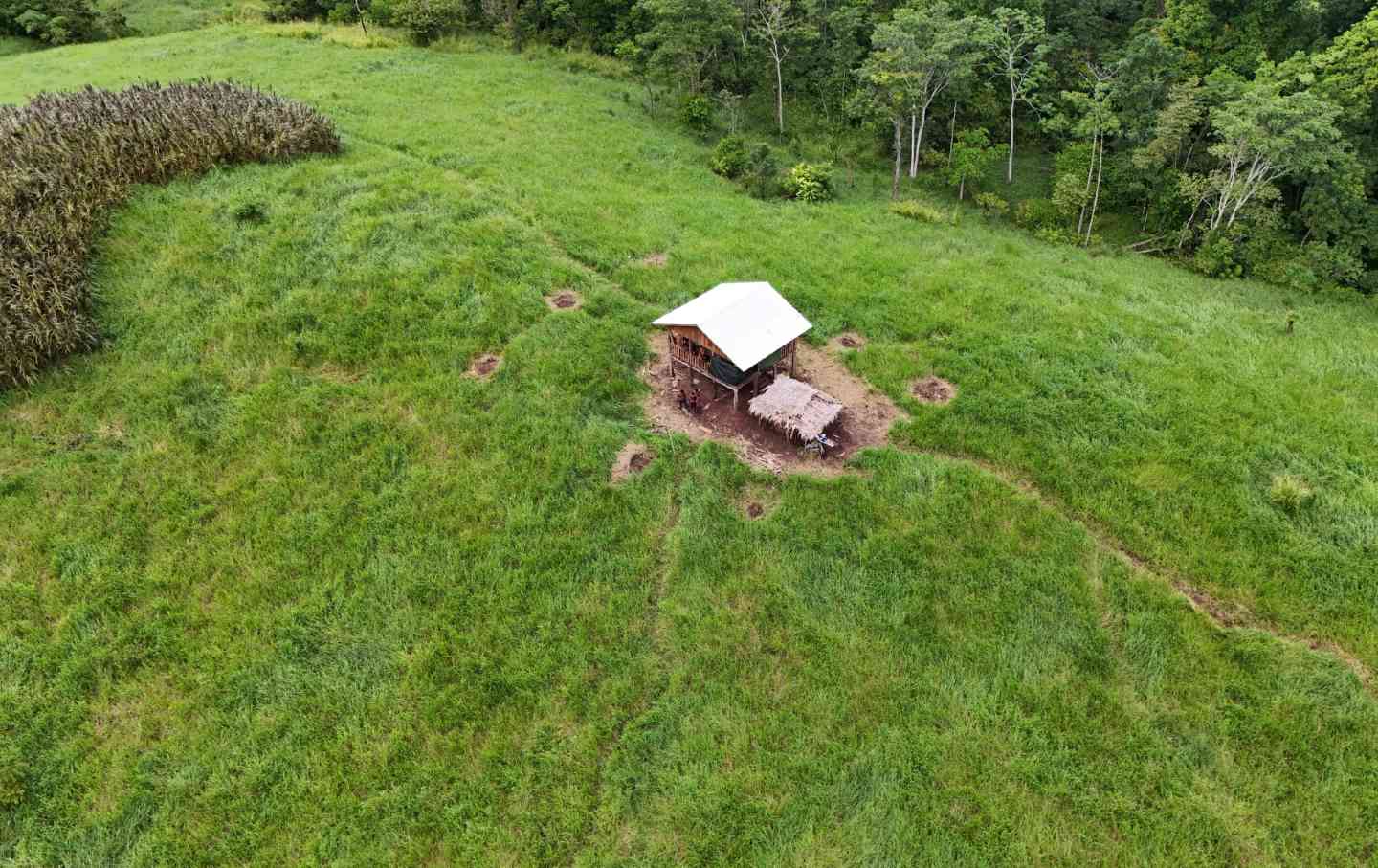
A wood hut in Mavita.(Roberto Lovato)
Thoughts of assassinations, narco planes, and corruption melted before the sight of the morning mist hovering over the hills above the tropical savanna grass, coconut palms, and pine trees surrounding Mavita’s wood huts.
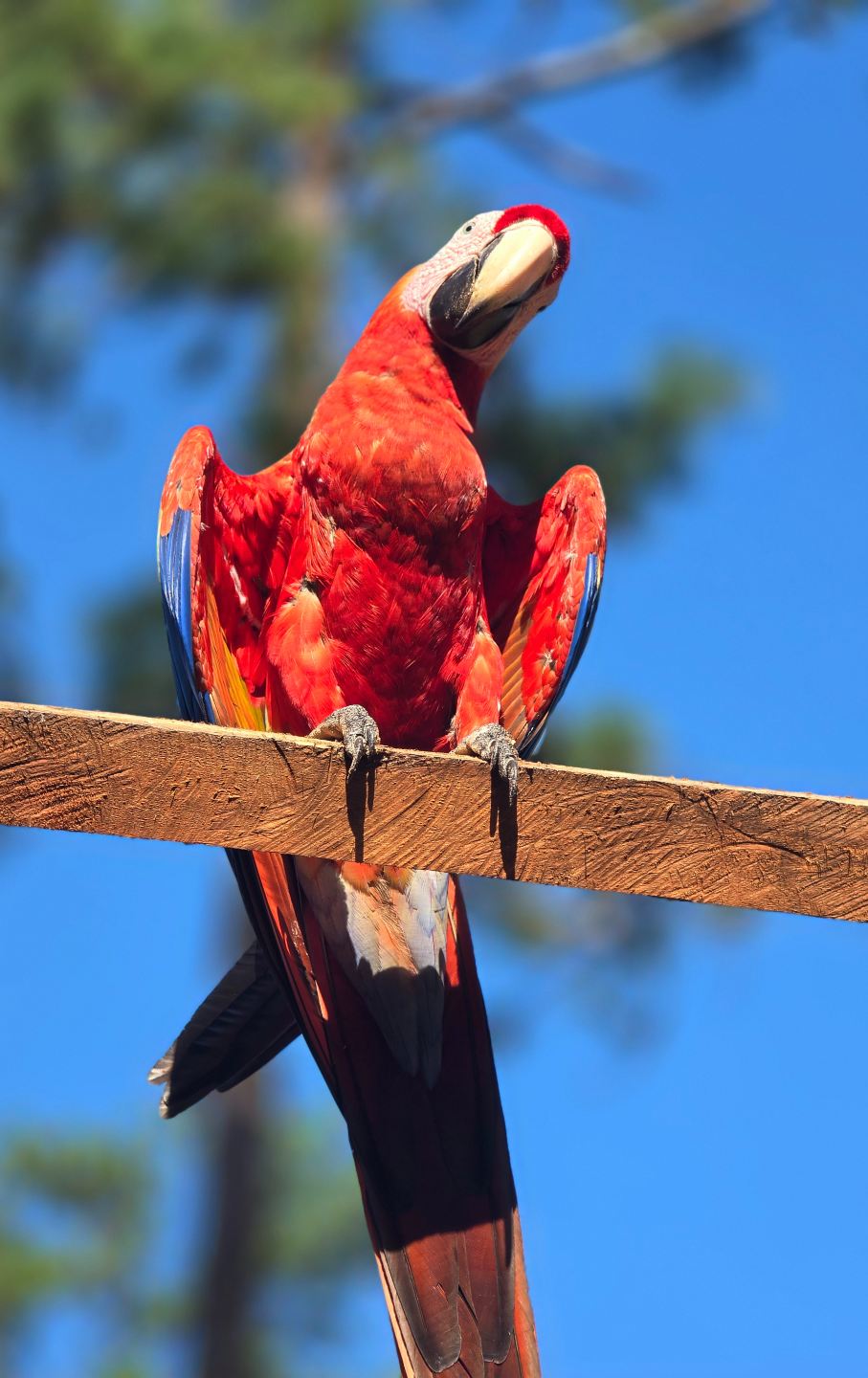
It was 5 am. The sun was rising. So was the bird whose bright red head, neck, chest, and wings have inspired native peoples across the continent for millennia to associate it with the sun and light.
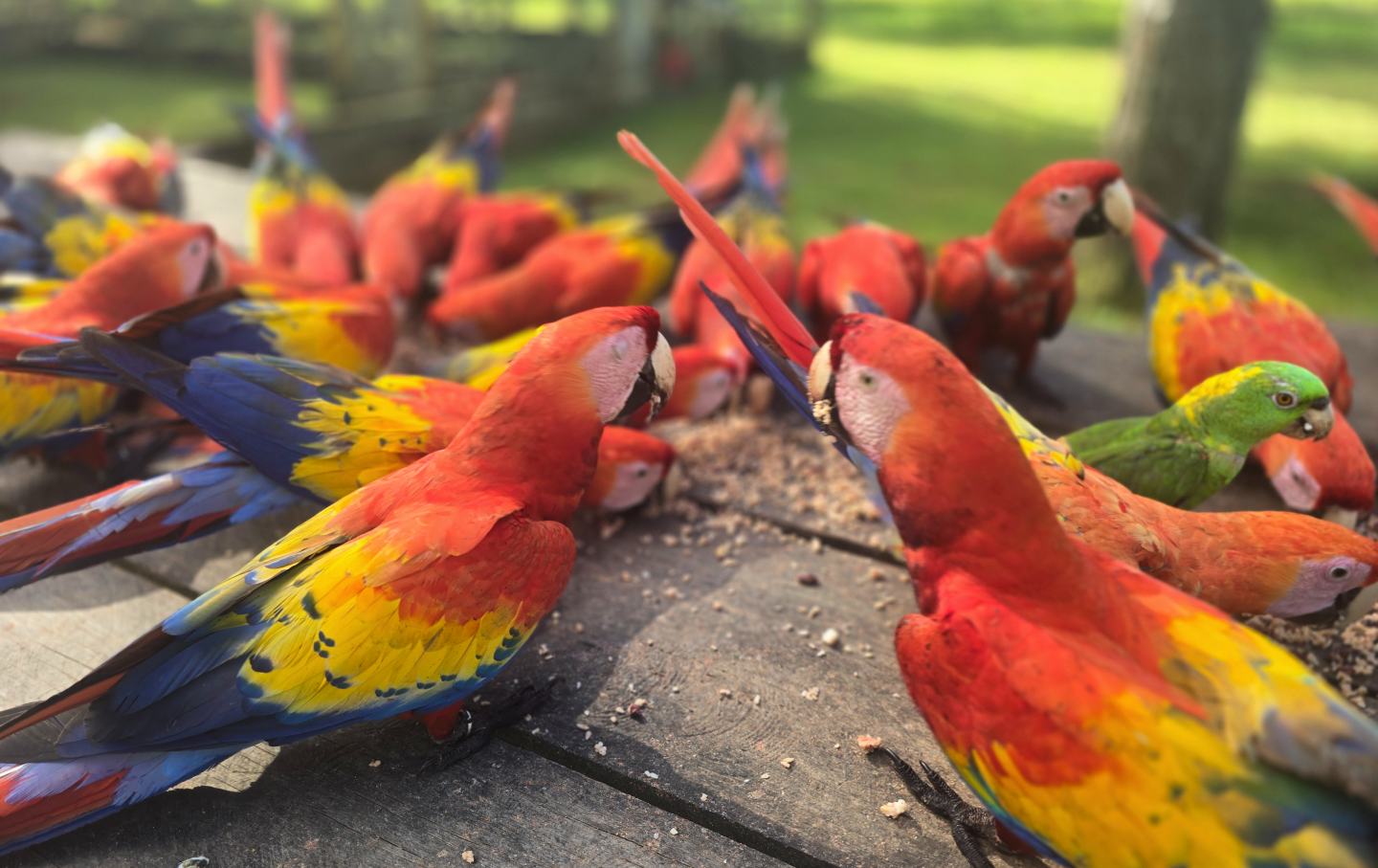
Synchronized with the dawn, scarlet macaws began to fly around the village. Dozens of red, yellow, and blue streaks descended from the pine trees into the grassy spaces between Mavita’s wooden huts, offering a glimpse of what human-macaw coexistence has likely looked like for much of history. Soon the birds erupted into the squawks that for centuries would have marked the start of day—its loudest moment—across Indigenous settlements throughout the tropical Americas.
Recorded at over 102 decibels from 15 feet, these squawks are louder than a Harley Davidson without a muffler, and they signal that it’s time for Anayda Pantin and her assistants to begin their daily ritual of feeding the scarlet macaws.
“Bal patampis bal. ¡Bal patampis bal!” Pantin, Santiago’s wife, said, calling the macaws to feast on the cart full of rice mixed with beans, yucca, and plantain she feeds the birds with twice a day.
“We sometimes run out of money and can’t buy them their food,” she said as she shoveled out breakfast for the 30–40 macaws that descend on the cages where another dozen or so macaws are healing in the Rescue and Liberation Center of La Moskitia, which Pantin founded and codirects with Lacuth. “Even when there’s no money,” she added, “we always find something to give them.”
As years passed and she married, she and Lacuth started noticing that the skies were less luminescent. Fewer and fewer birds flew in and around Mavita. “We started counting them and noticed that the number of scarlet macaws was decreasing. So we started feeding and caring for them at home.”
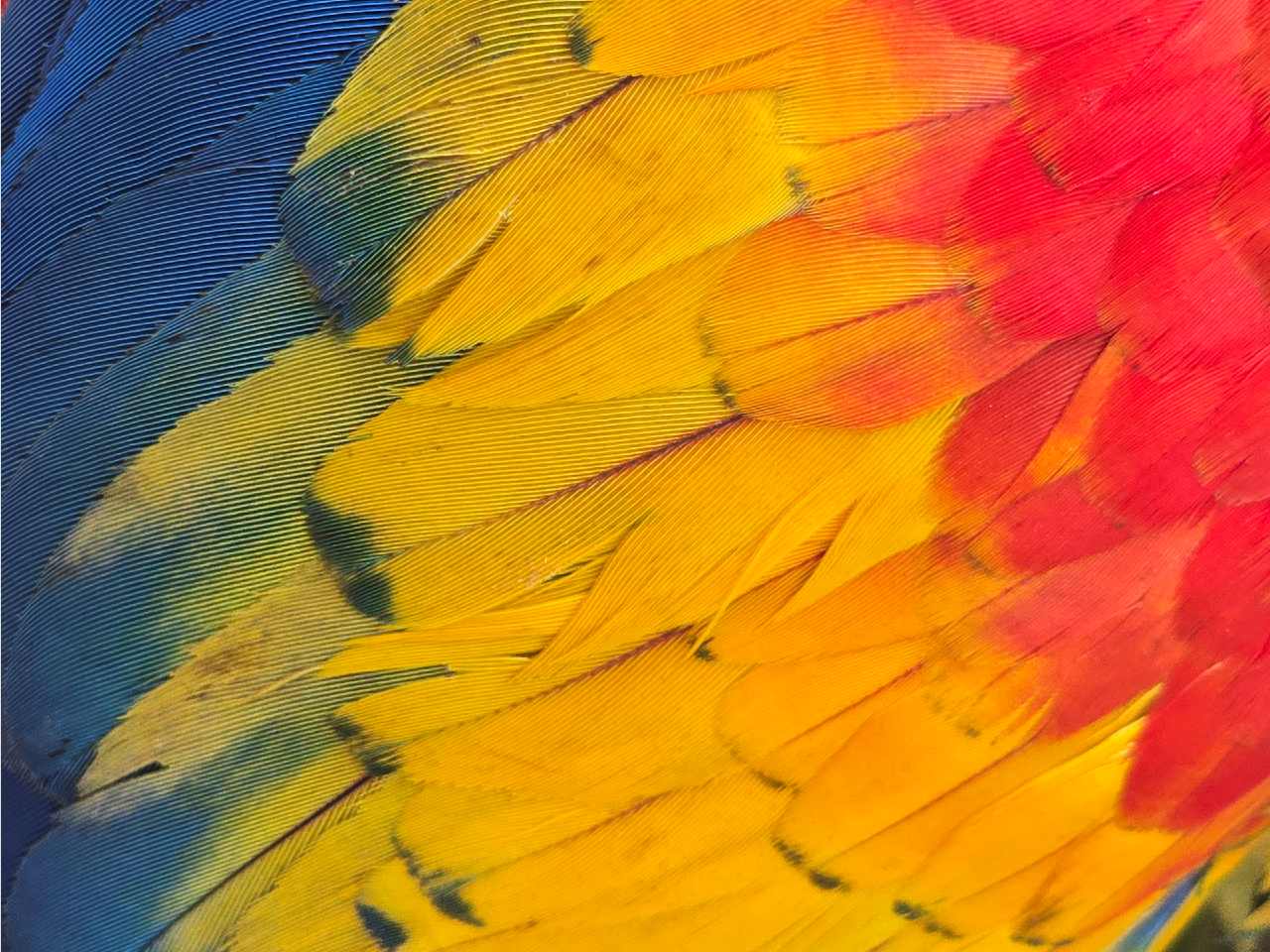
Th iridescent feathers of the scarlet macaw. (Roberto Lovato)
Their efforts drew the attention of police and military personnel who began to bring them confiscated birds, many of whom were abused and injured by poachers or their former owners. As the number of macaws grew, Pantin and Lacuth sought the help of Miskito authorities and NGOs, formalizing their work with the help of Honduran conservationist Hector Portillo Reyes, who had spent years in the region.
Soon after, Reyes introduced them to Joyner. Her organization, One Earth Conservation, raised funds, conducted classes on parrot conservation, and set up labs and veterinary clinics. The work of monitoring nests and patrolling forests eventually got a boost from drones, motorbikes, cameras, and other technical assistance.
Joyner also helped them draw more international attention to Mavita, one of the few places in the world where scarlet macaw preservation is led by Indigenous people. Forced by hunger and poverty, locals—Miskitos and non-Miskitos—had poached so many birds that, between 2005 and 2010, the scarlet macaw population in the area had dwindled from 500 to 100 birds.
Joyner and One Earth Conservation responded quickly, providing more funds. The Apu Pauni Project made an enormous difference, safeguarding over 1,000 nests, reducing scarlet macaw poaching by 80 percent thanks to Miskito-led patrols of over 500,000 acres of territory. Dr. Donald Brightsmith, a leading ornithologist and parrot expert based at Texas A&M, told me that Miskito efforts to preserve the scarlet macaws are “incredibly important” because they are “not just fighting and risking their lives for a species, but for an entire ecosystem.” The Apu Pauni Project also provides education, employment, and other benefits to the community.
Pantin departed for a while and returned to a large cage carrying a white cloth bag that’s moving from within. “This little one was injured,” she said while looking at the bird struggling to get out of the bag. “Are you ready? Are you ready?”
The bird broke free, hobbled around the table, and grabbed a nearby tree branch set up in the “liberation center”—a place for birds to practice flying before being set free.
“It was injured, and I had to pick out its feathers one by one to allow it to grow new ones,” she explained as the bird started to flap its newly feathered wings. “It’s trying to get used to them.”
“Being free takes a lot of work,” she said. And at that moment, the bird began its first flight in the large cage. Pantin’s eyes welled up: “It causes me great emotion to see them fly again—or fly for the first time.”
After several minutes, she left the bird to its newfound flight and stepped outside. The wooden table that had been covered with rice, beans, and plantain was suddenly overrun with iridescent blues, yellows, and reds, as the macaws feasted. When finished eating, some of the macaws played; others stared while hanging upside down on a wood plank set up nearby; still others pecked playfully at the feathers of their mates—the only ones these monogamous birds will have for decades (they can live up to 70 or 80 years).
“These birds are very smart,” she said. “They understand a lot of Miskito words.”
The bonds between the birds and Miskitos like Pantin are palpable. I watched Pantin’s son, Wesley, climb a 100-foot-tall Caribbean pine. After a few minutes, he reached the hole in the tree where some macaws nest, turned on the head-mounted camera on his yellow helmet, and started transmitting images to a laptop below. I found the images of tiny, featherless newborn macaw chicks crawling to warm each other in the nest moving, the embodiment of forest vulnerability.
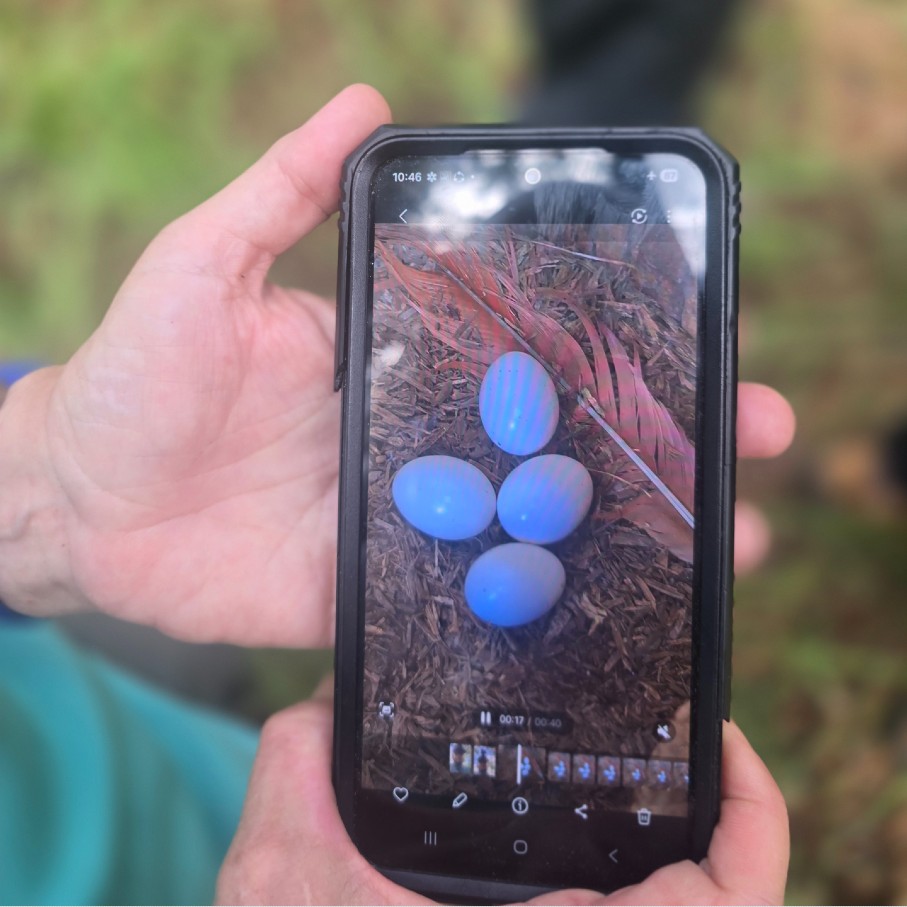
Equally striking was the response to the video from Joyner, Lacuth, and the volunteers down below who came on the monitoring excursion: They repeated and cried out, “¡Es un milagro, es un milagro!”—it is a miracle—at the sight of four eggs in a nest, along with three newborn. The average scarlet macaw nest has about three eggs.
Four eggs! ¡Es un milagro!(Roberto Lovato)
I suspect that scarlet macaws are so moving to people because they are sensitive to human feelings. “They feel what we feel,” Pantin said. “I think they know when I’m sad. Sometimes, they don’t want to eat and just stay sad.”
The emotional reciprocity she described echoes the findings of researchers who told me that because scarlet macaws depend on the flock for survival, they have evolved a preternatural ability to connect and feel. And this ability extends not just to other parrots but to the humans they encounter. It’s perhaps why in the United States, Veterans Affairs psychologists use macaws and other parrots to treat PTSD in war vets.
Scientists and Mavita locals have also told me that the birds may also experience trauma from natural disasters, predators, and the greatest threat they face here: poachers.
“I used to climb the trees, find the nests, take the guara eggs, and sell them,” Tomas Manzanares, a Miskito man from the nearby village of Rus Rus, told me.
In the 1990s, he explained, poachers sold eggs and birds locally to buyers from other parts of Honduras, who then resold them as pets or to hotels and tourist destinations.
“I grew up when the guaras were everywhere you looked,” he said. “But I had a family and needed to feed them. There was no work here. It hurt my soul, but necessity obligated me to sell them.” Manzanares’s statements made sense; according to the World Bank, 72 percent of Indigenous households in La Moskitia cannot afford a basic food basket.
Today, that trade has become more international, as Jarri Lacuth, my Miskito-language teacher, made clear. From his family’s thatched-roof wooden hut, Jarri Lacuth told me that he went to in Nicaragua to find out who was purchasing the eggs, and to do so, he had to go undercover.
“I spoke with the main buyer in Esperanza, Nicaragua, where we have Miskito family,” he said. “He’s from Taiwan but spoke good Spanish with a Chinese accent. Somebody told him I work with scarlet macaws.”
“One day,” Jarri continued, “he showed up asking for me. We met at an office in Esperanza, and he showed me pictures of all the eggs and parrots he had. He sells them to zoos, individuals, and other buyers. He asked me how many nests we have near Mavita. He offered about 10,000 cordobas ($272) per guara and up to 200,000 cordobas ($5,445) for 120 eggs. He showed me photos of people in a laboratory feeding 300 to 400 chicks with a syringe in special cages they buy. He offered me work and to be allied with him. People have seen him and others in boats on the rivers, going from town to town offering people money for guara. What he wanted most were eggs. Lots of poachers in Nicaragua and La Moskitia work with him. Authorities are after him, but he’s avoided capture for a long time.”
The Taiwanese buyer is only part of the confluence of criminal interests that threaten the ecosystem: There’s also the terceros, who destroy thousands of acres of pine forest and rainforest for illegal cattle ranching and logging; corrupt government officials and politicians who find creative ways to avoid Miskito and Honduran laws protecting the land, macaws, and people; poachers who steal eggs and birds to sell to illicit national and international markets—all of whom are protected by criminal organizations that operate in La Moskitia.
Coastal and other Miskitos tell stories of roads and sea routes that regional criminal groups like the Cachiros and the Atlantic Cartel control. And everywhere you go, you hear tales of macaws owned and raised by the mysterious narcos who built and lived in now-abandoned mansions inland and along the coast.
The narco bird lovers in La Moskitia and across Honduras reflect how the country’s official bird also symbolizes the noxious effects of the corruption that threatens the bird and its tropical habitats. “The narcos share an interest in continuing the poaching, land grabs, and other activity of the terceros,” Santiago Lacuth told me. “None of them wants any attention to what’s happening here. That allows them to keep doing their drug business while getting cover from the terceros who steal, buy, and sell land that no one can touch or even visit because it’s protected by the narcos.”
The drug ecology here in Gracias a Dios and other parts of Honduras has made cartel and gang members in Honduras rich and powerful. “The narcos and terceros are taking over and destroying thousands of hectares of land,” Lacuth continued. “Because we’re so poor here, even some Miskitos are violating our laws prohibiting private property and selling it for the terceros and narcos.”
Enabling their influence are politicians in Honduras, where for decades, “corruption is the operating system” of the government, according to a report by the Carnegie Endowment for International Peace. The contradictions and absurdity of the corruption were on display earlier this year, as Juan Orlando Hernandez—the Honduran president whose administration put the macaw on the $200 lempira bill and supported anti-deforestation and macaw reintroduction programs—was granted a “full and complete pardon” by Donald Trump, after serving just three years of a 45-year sentence for drug trafficking and firearms. Many in Mavita believe that this corruption swallowed government funds committed to protect the scarlet macaw and its habitats. President Nasry Asfura’s Secretariat of Natural Resources and Environment did not respond to multiple requests to comment on where the 1 million lempiras ($37,500) approved to protect the scarlet macaw went. The Apu Pauni Project has not seen any of it.
In recent months, the poaching has reached crisis levels. Outsiders have raided 19 of the 106 active scarlet macaw nests identified by the Apu Pauni Project, according to Joyner.
“This is the worst year for trafficking,” Joyner said. “People are selling the eggs for what are incredible amounts of money here.” She said that one group was intercepted at an international airport with nearly 300 eggs.
In response to the crisis, the Miskitos, Joyner, and the people of Mavita have launched the Unconditional Solidarity campaign, which is aimed at telling the world about the poaching surge and pressuring Honduran authorities to intervene more forcefully.
“We’re signaling ‘emergency,’ because we can’t stop poaching without greater involvement,” she said. “We can’t just have the local Miskito community and a couple of nonprofits taking on the gigantic narco system. If we fail, all the nests will be poached.”
So far, the campaign appears to be having an impact, Joyner said. “Everybody in Puerto Lempira is watching the campaign on social media. Security forces are doing regular checkpoints, and the government has committed some military personnel to increase the patrolling for poachers. We’ve raised some money and raised the level of awareness. People who see us on the road stop and say, ‘You’re the people we see talking on TikTok about the guaras.’”
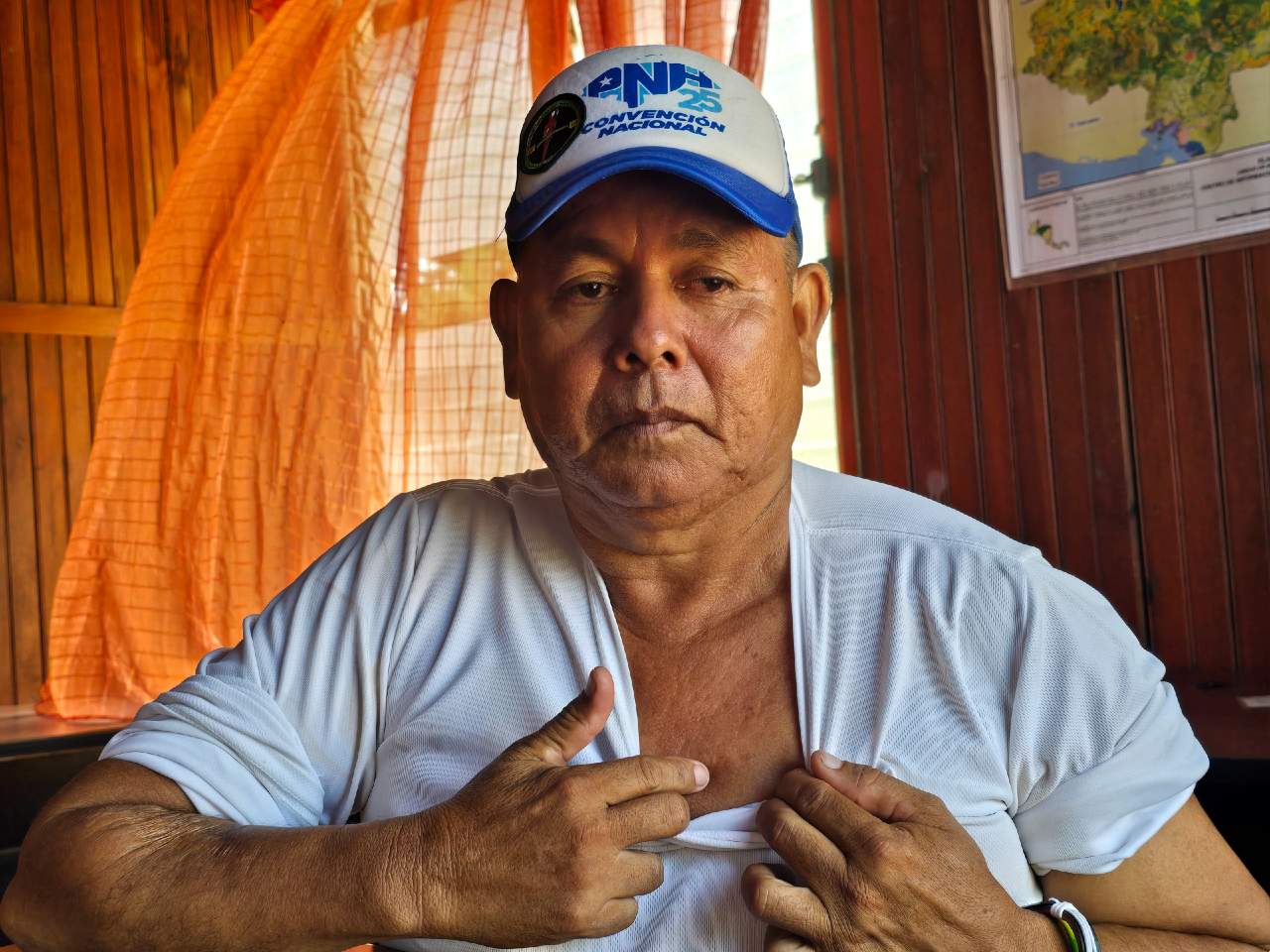
These efforts have reinforced the shift already underway among some former poachers. Manzanares told me he stopped poaching in 1998 and began educating others about why it was wrong to rob chicks and eggs from their mother. His transformation came at considerable cost: He showed me scars from gunshot wounds.
“I was swimming in a river next to the main road one day, enjoying the sun and beauty,” he told me from the office of the NGO he works at in Puerto Lempira. “And then I felt the burning sensation here [he pointed to his right forearm], here [then to his upper right arm]. There are nine screws here [left arm]. This one [pointing to his chest] came this close to my heart and punctured my lung. The bullet is still in my back.”
Tomas Manzanares points to where a bullet punctured his lung.(Roberto Lovato)
He told me this having just returned from patrolling and putting out fires set by terceros and that he was afraid that inhaling the fumes were making him sick.
Why continue?
“Because the guara shows me the saddest and most beautiful things,” he said without hesitation.
He described watching macaws circle above burning pine forests as they searched for “their chicks who were burning to death on the ground.”
“It makes me extremely sad and hits me here,” he said, pointing again to his chest. “But watching them hatch, grow feathers, and fly makes my heart open.… They feel happy when we’re protecting them. That’s why I do my part.”
7 Things You Can Do To Change Your Life When You’re Just Sick Of It
YOU ARE AT:
Home » Life » 7 Things You Can Do To Change Your Life When You’re Just Sick Of It
7 Things You Can Do To Change Your Life When You’re Just Sick Of It
Disclosure: this page may contain affiliate links to select partners. We receive a commission should you choose to make a purchase after clicking on them. Read our affiliate disclosure.
Reviewed and edited by Anna Phillips-Waller, BSc Psych | Health Behavior Change & Clinical Trials Expert
Feeling sick of your life deserves your attention. That exhaustion, that bone-deep frustration with how things are—those feelings are trying to tell you something important. You’re not broken for feeling this way. You’re not ungrateful or weak or doing life wrong. You’re human, and you’ve hit a wall that signals something needs to shift.
The good news is that you have more power to change things than you probably realize right now. Change doesn’t always mean burning everything down and starting over. Sometimes, it means precise and deliberate changes, targeting exactly what’s making you miserable rather than overhauling everything at once. You can feel different about your life without necessarily changing every single thing in it.
What follows are seven practical actions that can help you move from feeling trapped to feeling like you have some control again.
1. Identify what, specifically, you are sick of.
Saying, “I’m sick of my life” feels true when you’re in that headspace, but, often, what you’re actually sick of is two or three specific things that are contaminating everything else. Those bad elements can make your whole life feel unbearable, even when other parts are actually okay.
Your brain doesn’t naturally think this way when you’re overwhelmed. Everything blurs together into one big mess. But if you take the time to dig into specifics, you’ll almost always find that the misery has sources you can name.
Ask yourself these forensic questions:
When exactly do you feel worst? Monday mornings might point to job issues. Sunday evenings might mean you’re dreading the week ahead. After work could mean your home situation needs attention.
Where are you when the feeling hits hardest? Your office, your commute, your bedroom, certain social settings? Location tells you something.
Who are you with or thinking about when you feel this way? Sometimes, one toxic person poisons a whole friend group. Sometimes, it’s not even a bad person—just someone whose energy drains you.
What were you doing in the ten minutes before that “I hate everything” feeling crashed over you? Were you dealing with a particularly difficult customer at work? Were you walking home in the wind, rain, and cold?
What single change would make you feel just five percent better right now? Not fixed, not happy—just slightly less miserable.
People misdiagnose their problems constantly. You think you hate your job when you actually hate your commute or one specific coworker. You think you need to end your relationship when you actually just need a little more “me” time. You think you’ve outgrown your city when you really just need a better apartment or neighborhood. You think your career is wrong when it’s your company’s culture that’s a wrong fit.
Try this exercise. List every major life element: job, relationship, home, city, friends, family dynamics, daily routine, health, finances. Rate each one from one to ten. Anything below five needs your attention. Anything at three or below is likely making you miserable in ways that bleed into everything else.
MY LATEST VIDEOS
Video Muted
Sometimes, the problem isn’t what’s present but what’s missing. Purpose, community, time in nature, creative outlets, genuine alone time, intellectual challenge—these absences create their own kind of suffering.
2. Identify things you are tolerating unnecessarily (and act on them).
You’re probably putting up with dozens of small annoyances that seem too minor to matter individually. Squeaky doors, uncomfortable shoes, friends who always cancel, burnt-out lightbulbs, clothes that don’t fit right, apps you never use, subscriptions you forgot about, social obligations you dread.
Each one whispers in the background of your mind. Your brain tracks unresolved problems even when you’re not actively thinking about them. Every toleration is a tiny drain on your mental battery. Thirty of them together can make you feel exhausted without knowing why.
Most people don’t realize how much energy they’re spending on things they could actually fix or eliminate. You’ve gotten so used to working around problems that you’ve stopped seeing them as optional.

Spend an hour making a list of everything you’re tolerating. Walk through your home and notice what annoys you. Think through your relationships and notice which interactions consistently drain you. Look at your calendar and notice what you dread.
Organize your list by how much effort each thing would take to resolve. Some tolerations take ten minutes to fix. Others need a difficult conversation. Some require acceptance because they can’t actually change.
Start with quick wins. Unsubscribe from five emails that clog your inbox. Delete apps you never use. Replace that lightbulb. Toss expired items from your fridge. Unfollow social media accounts that make you feel bad. These tiny actions create momentum and free up mental space immediately.
Medium-effort items might take an hour or two. Fix something that’s been broken for months. Organize one drawer or closet. Review your subscriptions and cancel what you don’t use. Return something you’ve been meaning to return. Make that doctor’s appointment you’ve been avoiding.
The hardest tolerations involve boundaries and conversations. Telling a friend you can’t be their only emotional support. Declining recurring social plans that exhaust you. Addressing a dynamic in your relationship that isn’t working. Setting limits at work. These feel risky, but they often bring the most relief.
Eliminating even ten tolerations—especially small ones—creates a disproportionate sense of relief. You’re not fixing your entire life. You’re just removing unnecessary friction that’s been wearing you down without you fully realizing it.
3. Design your “bare minimum life”.
When you’re exhausted by trying to keep up with everything, it helps to imagine the simplest version of your life you could genuinely accept. What would that look like?
Most people discover something surprising when they do this exercise: some of what fills their time is actually optional. You’re doing it out of obligation, guilt, or habit—not because it genuinely matters to you.
Subscribe to receive our latest articles!
🙂One convenient email, no spam, easy to unsubscribe.
Here’s how to find out what actually matters. If you could only maintain three commitments, which would you choose? If you could only nurture three relationships, who would they be? If you could only do three activities each week, what would bring you the most value?
What are your absolute non-negotiables for mental health? Maybe it’s eight hours of sleep, time outdoors, and one evening alone each week. Maybe it’s exercise, creative time, and regular connection with your best friend. Whatever they are, name them.
Now go through your typical week and label everything as either a genuine want, a “should,” or unclear. Genuine wants are things you’d choose even if nobody expected them. Shoulds are obligations you’ve taken on because of external or internal pressure. Unclear means you honestly don’t know if you want this or just feel like you’re supposed to.
You’ll probably find that most of your shoulds are self-imposed rules that nobody else even cares about. You think you should host holidays, attend every event, keep your home a certain way, maintain certain friendships, present a particular image. But if you stopped doing these things, would anyone actually mind? Would you?
Good enough is genuinely good enough. Perfectionism creates exhaustion. So, ask yourself: what would acceptable look like instead of perfect? What would maintenance mode look like instead of constantly improving and optimizing?
Subtraction creates space. You can’t add what matters if your life is already full of what doesn’t. Giving yourself permission to do less often reignites your energy. Once the pressure is off, you might naturally want to do more—but now it’s coming from genuine desire rather than obligation.
4. Implement regular “energy accounting”.
Lots of people track time, but almost nobody tracks energy. Two hours scrolling on your phone and two hours hiking both cost two hours. But the energy impact is completely different.
For one week, keep simple notes about activities, people, and situations. Mark each one as an energy giver (+), energy taker (-), or neutral (=). Energy givers leave you feeling alive, capable, and replenished. Energy takers leave you feeling drained, depleted, and irritable. Don’t overthink it—just notice the pattern after each significant activity or interaction.
You’ll discover surprising things. That “relaxing” TV time might actually drain you. Exercise you resist might energize you. Certain people consistently exhaust you even though you think you should enjoy their company. Some work tasks energize you while others deplete you.
It’s important to note that introverts and extroverts have opposite energy patterns. Social interaction might energize extroverts but drain introverts, who recharge in solitude. Neither is wrong. You need to design for your actual wiring, not what you think should work.
Active rest is different from passive rest. Active rest might be walking in nature, playing music, or doing something creative. Passive rest is scrolling, watching TV, lying around. Both have their place, but active rest often restores you more. Track which your body actually needs in different moments.
Feeling challenged often energizes you when you’re stretched but capable, whereas overwhelm depletes you when the difficulty exceeds your capacity. Learn to tell the difference so that you can seek the right amount of challenge.
Once you have a week of data, you can start to make strategic choices. Can you reduce exposure to consistent energy drains? Can you increase access to things that reliably energize you? Can you pair necessary energy-taking activities with energy-giving ones? Can you schedule demanding tasks for times when your energy naturally runs higher?
Some energy takers are necessary. Work you must do, caregiving responsibilities, dealing with bureaucracy—these can’t always be eliminated. But you can stop choosing optional energy drains. And you can make sure you’re getting enough energy deposits to offset the necessary withdrawals.
5. Focus on feeling alive rather than being productive.
Measuring success only by productivity—tasks completed, money earned, things checked off—will only give you conventional results. Those results often feel soul-deadening even when you’re “succeeding.”
Try measuring something different. Instead of asking what you accomplished today, ask when you felt most alive. When did you laugh? When were you fully present, not thinking about the past or worrying about the future? When did time feel expansive instead of scarce?
When did you feel like yourself rather than performing a role? When did you feel connected—to yourself, to another person, to nature, to something larger? What gave you goosebumps or made you catch your breath?
Keep it simple so this doesn’t become another obligation. Write one sentence in your notes app before bed. Record a thirty-second voice memo before brushing your teeth. Drop slips of paper with aliveness moments into a jar to revisit later. If daily feels like too much, reflect on your week’s aliveness peaks every Sunday evening.
These psychological concepts are worth thinking about when cataloging things that contribute to your aliveness: “Vitality”—the subjective experience of feeling alive and energized. “Mattering”—the feeling that your existence makes a difference. “Flow”—when you’re so absorbed you lose track of time. “Presence”—when your brain isn’t stuck in past regrets or future anxieties.
We measure what we value. If you only measure productivity, you’re implicitly saying output matters more than lived experience. Tracking aliveness reorients your attention toward the quality of your days, not just what you produced during them.
After tracking for a few weeks, patterns emerge. What types of activities show up repeatedly in your aliveness moments? Which people appear most often? What time of day do these moments cluster? What’s filling your calendar but never appears in these reflections?
Use that data to redesign your life. You’re not guessing what might make you happier. You’re working with actual evidence of what does.
6. Audit your media diet.
Your consumed content shapes your worldview, energy levels, and sense of what’s possible. Most people don’t realize how profoundly their media diet affects them because they’re consuming mindlessly.
Track everything you consume for three full days. Social media—which platforms, how long, what content. News—sources, frequency, format. TV shows and movies—genres, themes, emotional tone. Podcasts, music, books, articles, YouTube, TikTok. Even conversations—do they focus on gossip, complaining, politics, or ideas?
Don’t judge yourself during the audit. Just observe honestly.
Then analyze what you found. What content left you feeling energized, inspired, capable? What left you anxious, depleted, inadequate, angry? What helped you numb out or dissociate? What triggered comparison and envy? What made you feel behind in life or focused on what you don’t have?
How much of what you consumed did you actively choose versus what the algorithm fed you? How much was intentional versus procrastination? What actually taught you something or moved you, versus just filling time?
Social media and news are designed to trigger engagement through outrage, fear, and urgency. Your brain isn’t broken for getting sucked in. The platforms are engineered to be addictive.
Think of it as mental nutrition. Junk food is engineered to be hyper-palatable but nutritionally empty. Much online content is engineered to be engaging but mentally depleting. You can consume for hours and feel emptier afterward.
On the other hand, some content requires more effort—challenging books, educational podcasts, meaningful art—but leaves you genuinely enriched.
Try to replace rather than just remove. People fail at media changes when they only try to stop consuming. Your brain needs something to fill that space.
Instead of doomscrolling news, choose one trusted source and check it once daily at a scheduled time. Instead of social media comparison, unfollow anyone who triggers feelings of inadequacy. Curate your feed ruthlessly. Follow creators who inspire rather than deflate you. Instead of passive TV to relax, ask yourself if it genuinely restores you or just numbs you. If it’s numbing and that’s not what you need, try active rest like an audiobook walk or making something with your hands.
Instead of constant background podcasts or music, try silence sometimes. Or switch to instrumental music that doesn’t demand your attention. Instead of only consuming others’ content, create your own occasionally. Journal, draw, write something, make anything.
Unfollow ruthlessly. You don’t owe anyone your attention. If seeing their content makes you feel worse, unfollow or mute without guilt. Turn off notifications. Almost nothing requires an immediate response. Batch-check instead. Remove apps from your phone.
Use “Not Interested” aggressively on YouTube and TikTok. Unsubscribe from emails. Leave groups that don’t serve you. Subscribe to one thoughtful newsletter. Follow one creator who teaches something genuinely useful. Join one community focused on growth rather than gossip.
Pick three to five specific changes based on your audit. Two or three things to reduce or eliminate. One or two things to add or increase. Implement these for two weeks and notice the impact on your mood, energy, and outlook.


7. Talk to yourself differently.
The voice narrating your life inside your head is learned, not fixed. When you’re sick of your life, that voice is often actively hostile. Yet you can’t think the same thoughts and expect different results.
When you’re exhausted with life, your inner voice probably sounds like this: “I’m so tired of this.” “Nothing ever changes.” “I can’t do this anymore.” “What’s the point?” “Everyone else has it figured out.” “I’m stuck.” “It’s too late.” “I should be further along by now.”
These aren’t just thoughts passing through. They’re creating your emotional reality and shaping what seems possible to you.
Most negative self-talk is automatic. You don’t consciously choose it. Which is why catching it in action is the first step. When you notice yourself feeling worse, pause and ask what you were just telling yourself. Write it down without judgment.
Common patterns include all-or-nothing thinking—”Everything is terrible,” catastrophizing—”This will never get better,” mind reading—”Everyone thinks I’m failing,” should statements—”I should be more or different,” and overgeneralization—”I always mess this up.”
Just naming the pattern reduces its power. “Oh, I’m catastrophizing again” creates distance. You’re observing the thought rather than being consumed by it.
Labeling emotions specifically also helps. Instead of “I feel bad,” try “I’m feeling overwhelmed and a little hopeless.” Instead of “I’m stressed,” try “I’m anxious about the future and tired from poor sleep.” Instead of “I hate everything,” try “I’m frustrated with my job and disappointed about my weekend plans falling through.”
The more specific the label, the more you shift from emotional flooding to cognitive processing. You become a scientist observing your experience rather than drowning in it.
Or how about talking to yourself in third person, using your name or “you.” Instead of “I can’t handle this,” say “Rachel can handle hard things. She’s done it before.” Instead of “I always fail at this,” say ” Rachel has struggled with this, but she’s also succeeded at many things.”
You’d speak more compassionately and realistically to a friend than to yourself. Speaking in the third person helps you access that compassionate observer voice.
Another simple switch is to add “yet” to fixed-state thoughts. “I can’t change my situation” becomes “I haven’t figured out how to change my situation yet.” “I don’t have the skills for that” becomes “I don’t have those skills yet.” “Nothing works” becomes “I haven’t found what works yet.” The word “yet” implies possibility and process rather than permanent failure.
Next, question your thoughts instead of accepting them as facts. Ask: “Is this thought absolutely true? What evidence contradicts this? What would I tell a friend thinking this? Is this thought useful right now? What would be a more accurate way to describe this situation?” For example, when questioned, “I’m stuck” becomes “Am I actually stuck, or am I scared to make a change? What’s one thing I could do differently this week?”
Finally, reframe temporary circumstances so that they don’t become your identity. Shift from “I’m stuck” to “I’m currently in a situation I want to change.” From “I’m a failure” to “I’m struggling with this particular thing right now.” From “I’m always like this” to “I have a pattern I’m working to change.” From “This is just who I am” to “This is who I’ve been; I’m evolving.”
Note that none of this is toxic positivity. You’re not pretending everything is fine. You’re describing reality accurately instead of catastrophizing or overgeneralizing. Negative thoughts aren’t the enemy—they’re information. Depression tells you something needs to change. Anxiety alerts you to threats. The goal isn’t to eliminate all negative thoughts but to not be ruled by distorted or unhelpful ones.
This takes practice. You’ve been talking to yourself in certain patterns for years or decades. Change won’t happen overnight. The goal is catching yourself more often and choosing different thoughts when you can.
Choose one or two techniques that resonate most. Practice them deliberately for two weeks. You won’t transform your self-talk overnight, but you’ll start noticing patterns and having more moments where you can choose a different thought.
If you’re having thoughts of self-harm or suicide, or if negative thoughts are so pervasive you can’t function, these techniques supplement professional help—they don’t replace therapy or medication.
Final Thoughts: The Direction Matters More Than The Speed
Feeling sick of your life isn’t a character flaw. It’s a signal worth listening to. You’ve spent time now identifying what specifically drains you, what you’re tolerating unnecessarily, what truly matters versus what’s just noise. You’ve looked at where your energy actually goes and what makes you feel alive rather than just productive. You’ve examined what you’re feeding your mind and how you’re talking to yourself.
These aren’t small things. Each one shifts how you experience your days. Together, they can transform how your life feels without requiring you to blow everything up and start over.
But know that change often happens through accumulated small choices, not one dramatic gesture. You’re building something different now—a life that fits who you actually are instead of who you think you should be. Some days, you’ll backslide. You’ll fall into old patterns, tolerate things you meant to address, consume media mindlessly, speak to yourself harshly. That’s normal. Progress isn’t linear.
What matters is that you’re paying attention now. You’re making conscious choices instead of just reacting. You’re designing your life deliberately instead of letting it happen to you. That awareness alone changes everything.
You’re not stuck anymore, even if your circumstances haven’t fully shifted yet. You’re in motion. You’re creating possibilities where there weren’t any before. That’s how you stop being sick of your life—not by changing everything at once, but by changing what matters, one deliberate choice at a time.
Steve Phillips-Waller is the founder and editor-in-chief of A Conscious Rethink. He launched the platform in 2015, and it has since reached millions of readers worldwide. He has over 10 years of experience writing on mental health, relationships, and human behavior. Steve is known for his analytical yet accessible approach to personal growth, which is rooted in his BSc in Mathematics and Business from the University of Warwick.
His writing is informed by his own journey and his lived experience as an introvert and a father in a neurodivergent household. Under Steve’s leadership, A Conscious Rethink has grown into a trusted self-help resource, which delivers compassionate, evidence-based advice to a global audience.
Do not sell or share my personal information.
You have chosen to opt-out of the sale or sharing of your information from this site and any of its affiliates. To opt back in please click the "Reenable Personalization" link.
This site collects information through the use of cookies and other tracking tools. Cookies and these tools do not contain any information that personally identifies a user, but personal information that would be stored about you may be linked to the information stored in and obtained from them. This information would be used and shared for Analytics, Ad Serving, Interest Based Advertising, among other purposes.
For more information please visit this site's Privacy Policy.
CANCEL
CONTINUE
We'd like to send you our latest articles and updates. You can unsubscribe at any time.
Build Smarter, Adaptive, and Self-Driven Businesses
At Innings2, we go beyond automation. We design AI-powered solutions and Agentic AI frameworks that don’t just complete tasks — they think, learn, and proactively solve problems to deliver personalized customer experiences, predictive insights, and intelligent automation that drives growth.
Royal Challengers Bengaluru (RCB) is one of the most popular and widely supported franchises in the Indian Premier League (IPL). Since its inception in 2008, RCB has built a massive fan base thanks to its exciting style of cricket, star-studded lineups, and unforgettable performances.
A Brief History of RCB
Founded in 2008, RCB represents the vibrant city of Bengaluru. The franchise has been home to some of cricket’s greatest players, including Virat Kohli, AB de Villiers, and Chris Gayle. Over the years, these legends have helped create countless memorable moments for fans around the world.
Why RCB Has One of the Most Loyal Fan Bases
RCB’s supporters are known for their unwavering loyalty. Whether the team wins or loses, fans continue to fill stadiums and dominate social media with their famous slogan:
“Ee Sala Cup Namde!”
This passionate support has made RCB more than just a cricket team—it has become an emotion for millions of cricket lovers.
Star Performers Who Defined RCB
Virat Kohli
Virat Kohli has been the face of RCB for more than a decade. His consistency, leadership, and aggressive batting have made him one of the most successful players in IPL history.
AB de Villiers
Known as “Mr. 360,” AB de Villiers amazed fans with innovative stroke play and match-winning performances.
Chris Gayle
The Universe Boss entertained cricket fans with explosive batting and record-breaking innings, including one of the highest individual scores in IPL history.
Memorable Moments in RCB History
Multiple appearances in IPL playoffs.
Record-breaking batting partnerships.
Historic individual performances by Virat Kohli and AB de Villiers.
Some of the highest team totals ever recorded in IPL matches.
Thrilling last-over victories that kept fans on the edge of their seats.
RCB’s Strengths
Powerful Batting Lineup
RCB has consistently featured some of the world’s best batters, making them one of the most entertaining teams to watch.
Passionate Fan Support
The team’s supporters create an electric atmosphere both online and inside stadiums.
Strong Brand Presence
RCB is among the most recognizable franchises in cricket, with a global fan following.
The Future of RCB
As the franchise continues to evolve, fans remain hopeful that RCB will achieve even greater success in the coming seasons. With a blend of experienced players and emerging talent, the team is well-positioned to remain a major force in the IPL.
Conclusion
Royal Challengers Bengaluru is more than a cricket franchise—it’s a symbol of passion, resilience, and unwavering support. From iconic players to unforgettable matches, RCB continues to inspire millions of fans worldwide. As the team looks toward the future, supporters remain united in their belief that the best is yet to come.
Tags: RCB, Royal Challengers Bengaluru, IPL, Virat Kohli, Cricket, Indian Premier League, Bengaluru Cricket, RCB Fans
SEO Meta Description: Explore the journey, history, star players, memorable moments, and passionate fan culture of Royal Challengers Bengaluru (RCB), one of the IPL’s most popular franchises.
Rec.gov To Require Video Application For Permits In 2027 – Paddling Magazine
The official reservation site for public federal lands in the United States, Recreation.gov announced on April 1, 2026 that video applications will now be required for the most competitive permit lotteries, beginning in 2027. According to Rec.gov spokesperson Seymour Butz, the coming change is inspired by the success of hit reality TV series Naked and Afraid and comes with the goal of making sure permits go to the most qualified applicants.
Ad ends in 8
Video Unpaused
Recreation.gov representative shares story behind controversial move to integrate video auditions into permit application process
“Permits are so competitive these days and rescues are so costly that we’ve found we need a way to weed out the weak,” shared Butz.
Affected permit lotteries include high-demand recreation hotspots such as the Grand Canyon, Middle Fork of the Salmon River, or Selway River as well as backpacking destinations like Half Dome, the Enchantments and Mount Whitney. Rec.gov is partnering with the same casting company responsible for finding talent for popular outdoors reality television series Naked and Afraid to accept video submissions.
“We figured getting a permit for the Middle Fork of the Salmon is at least as competitive as getting on Naked and Afraid and thought we’d take a page from their book,” said Butz.
In order to secure your next permit, you’ll need to plead your case via video essay. Feature Image: Maddy Marquardt
Prospective paddlers will be required to submit a 90 second to 5 minute video application, covering previous outdoor experience, relevant certifications as well as a show of raw and rugged wilderness skills. Rec.gov notes that while personality and pizzazz aren’t expressly a factor on the permit competition rubric, a little razzle dazzle in the video certainly can’t hurt.
“Similar to Naked and Afraid, it doesn’t hurt to demonstrate your survival prowess and deep knowledge of fire, water, and shelter in your audition tape – er, permit application,” added Butz.
While the unprecedented move is designed to ensure competitive permits go to the most qualified candidates, Butz shared that having TV-ready personalities out in the wild is a plus.
“We’ve just seen the success of reality TV in America and think we’re really missing an opportunity to more effectively monetize American resources,” shared Butz. “It starts with the video applications, but it’s a long game. May the odds be ever in your favor.”
Citizens voice concerns about new video application
While representatives share enthusiasm for the coming change, paddlers and recreationalists are dismayed.
Paddler Eileen Offercliff expressed concerns about the coming change.
“Permits are already so hard to get,” said Offercliff. “Now you’re telling me we have to perform everything short of a song and dance to get on our favorite rivers? Access to rivers should be based on who has the most expensive and trendiest gear, not who makes for the best TV.”
Still other paddlers are unfazed.
“This might as well happen,” said a paddler and raft guide angling for a Grand Canyon permit who chose to be identified by trail name “Groover King”.
Groover King added that he believes his video application will perform well, as he is proficient in building massive bonfires, harmonica and groover duty.
To concerned permit applicants, Butz has a few words of encouragement.
“So many people want to visit these wilderness areas but they just don’t have the sheer backcountry survival skills, or on-screen personalities,” said Butz. “In a way, bringing a touch of reality TV to the everyday backcountry will make it more accessible for all. If you can’t get a permit, perhaps you can live vicariously through the screen.”
It seems that those most proficient in AI production will have the best chance of getting a permit.
There are records of those who have traveled whitewater before and those who have exceeded their expertise. That would be a more accurate predictor of who is most capable of safely navigating our waters and will have minimal impact on the existing beauty.
This is about as stupid and illogical an idea as Rec.gov could possibly dream up! It is a wholly unnecessary requirement that will minimize opportunities for far too many highly qualified boaters and hikers. It would be easier and more practical to just have line items on the on-line application form that lists qualifications and experience. How would anybody know if what is being included in a video application was true or valid? Next, they will just eliminate all permitting and ban us from all rivers!
What the heck does having charisma and a screen personality have to do with getting a permit? This opens the door wide to manipulate the permit process. PS my AI presentation, complete with MAGA hats all ‘round, is going to beat your experienced gay Hispanic group’s video every time.
I’d say it’s an April Fools Day joke but with this administration, of course it’s not. I mean what could go wrong? Other than denying permits to anyone who isn’t white and male…
Oops, I didn’t get to the bottom of your email, to see that this actually is a joke! LOL! I was going to ask you to not post my email, but now that I reread the last line of my comment, I think you actually should post it! Makes it even funnier.
That’s completely outrageous. The ability to make a flashy video has nothing whatsoever to do with the ability to successfully navigate a difficult river in possibly dangerous weather conditions. If the objective is really to reduce dangerous activities and costly rescues on the rivers, then the government should figure out a way to rate paddlers’ skills – perhaps something akin to BCU or other rating systems. But this stinks of other objectives – to award permits based on whether paddlers are pretty, funny, sexy, white-skinned, unaccented, wearing MAGA hats, or any number of totally irrelevant considerations.
You have chosen to opt-out of the sale or sharing of your information from this site and any of its affiliates. To opt back in please click the "Reenable Personalization" link.
This site collects information through the use of cookies and other tracking tools. Cookies and these tools do not contain any information that personally identifies a user, but personal information that would be stored about you may be linked to the information stored in and obtained from them. This information would be used and shared for Analytics, Ad Serving, Interest Based Advertising, among other purposes.
For more information please visit this site's Privacy Policy.
CANCEL
CONTINUE
Everything You Need to Know About Post-Spawn Bass – Wired2Fish
The product recommendations on our site are independently chosen by our editors. When you click through our links, we may earn a commission.
After an overview of the entire bass spawn, we’ve taken a deep dive into both the pre-spawn and the spawning phase itself. Now it’s time to discuss the post spawn, when bass can act pretty funny as they’re coming off the bed.
Some are super aggressive, gorging themselves on shad spawns, salad bars, and bream bed buffets. Others stay shallow and are super spooky, not prone to biting big, aggressive baits. Some hang around balls of fry, as the males guard them and the females try to eat them; these bass can be hard to get, but they are often catchable. Then there are those bass shooting straight to deeper water, looking to recover in the cooler temps around brushpiles and other cover and structure.
In short, there’s a lot going on in the post spawn. Here’s what you need to know.
Ad ends in 5
Video Unpaused
What is the Post Spawn?
“Post spawn” describes the immediate timeframe after the bass leave the beds, up to about a month removed. Bass typically spawn by moving shallow, fanning clean a spot to lay their eggs, and then depositing those eggs. This can be a grueling process that takes multiple days to complete.
After this is over and the eggs are out and hatched, the post-spawn phase begins. This can be a tough time to be a bass fisherman, as many of the fish are moody and reluctant to bite. But there are certainly ways to still catch them.
What Bass Are Doing
Bass are focused on a couple key things. Immediately after spawning, they are tired and hungry, having spent their energy getting eggs out and guarding their beds over the previous few days. These bass are looking to feed up and rest up. Some — the smaller males in particular — start to guard fry, making sure that nothing preys on those defenseless newborns. Interestingly enough, it’s the females who turn cannibal quite often and become the biggest threat to their newly hatched bass.
A week or so into the post spawn, bass start to leave their fry to hunt food. Some forage deeper, around brush and ledges. Others take advantage of various spawning baitfish, like shad and bluegill. These bass can be very aggressive, schooling up on those concentrations of bait.
Where to Look
Tune in to shallow cover to find the shad spawn. Shad spawn by rubbing up against something to get their eggs out. Anything like a floating dock, grass line, or seawall can be a great place to start. Then look for bream beds in shallow pockets and along flat, protected banks a little later in the post spawn.
For the early offshore bite, look for shallow cover like brush and boulders around shallow ledges and points where bass will hunker down for a few days and sometimes group up. Shallow is relative depending on where you are; whatever you consider deep, cut that in half and start by looking there.
Keep in mind that some older and bigger bass will head straight to the river channel immediately after coming off their beds. You can tell if you catch one offshore that’s fresh off the spawn because its tail will still be bleeding from the bed-making process.
Focus primarily on shallow cover along the bank to find forage, and then the first cover or structure out a little deeper. But keep the deep bite honest, too.
What to Fish With
A wacky rig, floating worm, Neko rig, drop shot, or other finesse-style bait works really well around fry-guarders. These bass can be weary and hard to catch, so something a little less intimidating works best. But these bass will also bite a topwater, like a small popper or a toad. Keeping a bait like this in your hand while covering water is a great way to locate and catch fry guarders, even if you have to slow down once you find them to catch them on a finesse bait.
For the shad spawn, a plethora of baits will work. Post-spawn bass are often going nuts for the first few minutes of the day. Since they’ll eat a lot of things, base your bait selection on the area’s conditions. If you’re fishing around vegetation, a swimjig is great. For fishing along a clean seawall, a topwater is fantastic. If the shad are spawning a little beneath the surface on hard bottom, a squarebill can be phenomenal. Basically, pick something you can fish efficiently, as well as something with a high-percentage landing rate.
For the bream beds a little later in the post spawn, I like to keep a topwater like a buzzbait or Whopper Plopper in my hand and cover water until I run into them. When I do collide with bass around a bream bed, they’ll often smoke the topwater. There are times, though, when slowing down and working a wacky rig, Neko rig, or dropshot through and around a bream bed will be more effective. But then pick the topwater back up and cover water until you find another concentration of bait and, hopefully, bass.
Moving to the shallow brush and cover, crankbaits and moving baits work well; however, slow bottom baits like casting jigs, Texas rigs, and shaky heads are even more effective. These bass are typically pretty easy to pinpoint, so using a search bait isn’t necessary. If you know where a brush pile, rock pile, or shallow drop off is, try dragging a bait near or through it — and be ready to set the hook.
Final Thoughts
As the bass spawn winds down, look for fish anywhere they can recuperate and feed. Shad spawns, bream beds, and other baitfish spawning activities can be hot beds of aggressive bass willing to bite almost anything. Others will be harder to catch, as they guard fry or float around shallow looking for an easy meal. Then there are the early offshore fish, which can be caught on a variety of baits. But slow-moving lures with good hookup and landing ratios are among the best options for these bass.
You’ll hear a lot of old heads talk about the “post-spawn funk.” Don’t let them fool you: The bass are still biting. It just takes knowing where to go, what to look for, and what to fish with. Once you dial in on these, the confidence kicks in and you’ll be on your way to catching post-spawn bass in no time.
Shaye Baker grew up fishing with his father in the state of Alabama. While in college, he was involved in the creation and early years of the Auburn University Bass Team, which expanded his testing grounds to the southeast. After college, Shaye began to fish the semi-pro circuit while simultaneously starting a freelance journalism career, providing content for Wired2Fish, FLW, B.A.S.S. and a few other publications.
As Shaye has transitioned from in front of the lens to behind it, his career has taken him to fisheries throughout the country and provided him intimate access to some of the best bass anglers to ever wet a line. Shaye now enjoys fun fishing and local tournaments with his father and friends, while working fulltime in the fishing industry as a freelance journalist shooting pictures and video, editing and writing.
You have chosen to opt-out of the sale or sharing of your information from this site and any of its affiliates. To opt back in please click the "Reenable Personalization" link.
This site collects information through the use of cookies and other tracking tools. Cookies and these tools do not contain any information that personally identifies a user, but personal information that would be stored about you may be linked to the information stored in and obtained from them. This information would be used and shared for Analytics, Ad Serving, Interest Based Advertising, among other purposes.
For more information please visit this site's Privacy Policy.
It seems that those most proficient in AI production will have the best chance of getting a permit.
There are records of those who have traveled whitewater before and those who have exceeded their expertise. That would be a more accurate predictor of who is most capable of safely navigating our waters and will have minimal impact on the existing beauty.
Must be an April fools day thing. It is isn’t it?
what day is this?
This is about as stupid and illogical an idea as Rec.gov could possibly dream up! It is a wholly unnecessary requirement that will minimize opportunities for far too many highly qualified boaters and hikers. It would be easier and more practical to just have line items on the on-line application form that lists qualifications and experience. How would anybody know if what is being included in a video application was true or valid? Next, they will just eliminate all permitting and ban us from all rivers!
April Fools!!!
What the heck does having charisma and a screen personality have to do with getting a permit? This opens the door wide to manipulate the permit process. PS my AI presentation, complete with MAGA hats all ‘round, is going to beat your experienced gay Hispanic group’s video every time.
Long live Groover King
Happy April 1st, Maddy!
And thank you for warning us about Seymour Butz’s plans for 2027!!
I’d say it’s an April Fools Day joke but with this administration, of course it’s not. I mean what could go wrong? Other than denying permits to anyone who isn’t white and male…
Oops, I didn’t get to the bottom of your email, to see that this actually is a joke! LOL! I was going to ask you to not post my email, but now that I reread the last line of my comment, I think you actually should post it! Makes it even funnier.
That’s completely outrageous. The ability to make a flashy video has nothing whatsoever to do with the ability to successfully navigate a difficult river in possibly dangerous weather conditions. If the objective is really to reduce dangerous activities and costly rescues on the rivers, then the government should figure out a way to rate paddlers’ skills – perhaps something akin to BCU or other rating systems. But this stinks of other objectives – to award permits based on whether paddlers are pretty, funny, sexy, white-skinned, unaccented, wearing MAGA hats, or any number of totally irrelevant considerations.
I can’t believe this is not a joke.